When anxiety suddenly feels physical, hormonal change may be part of the picture—but it is never the only diagnosis worth considering.
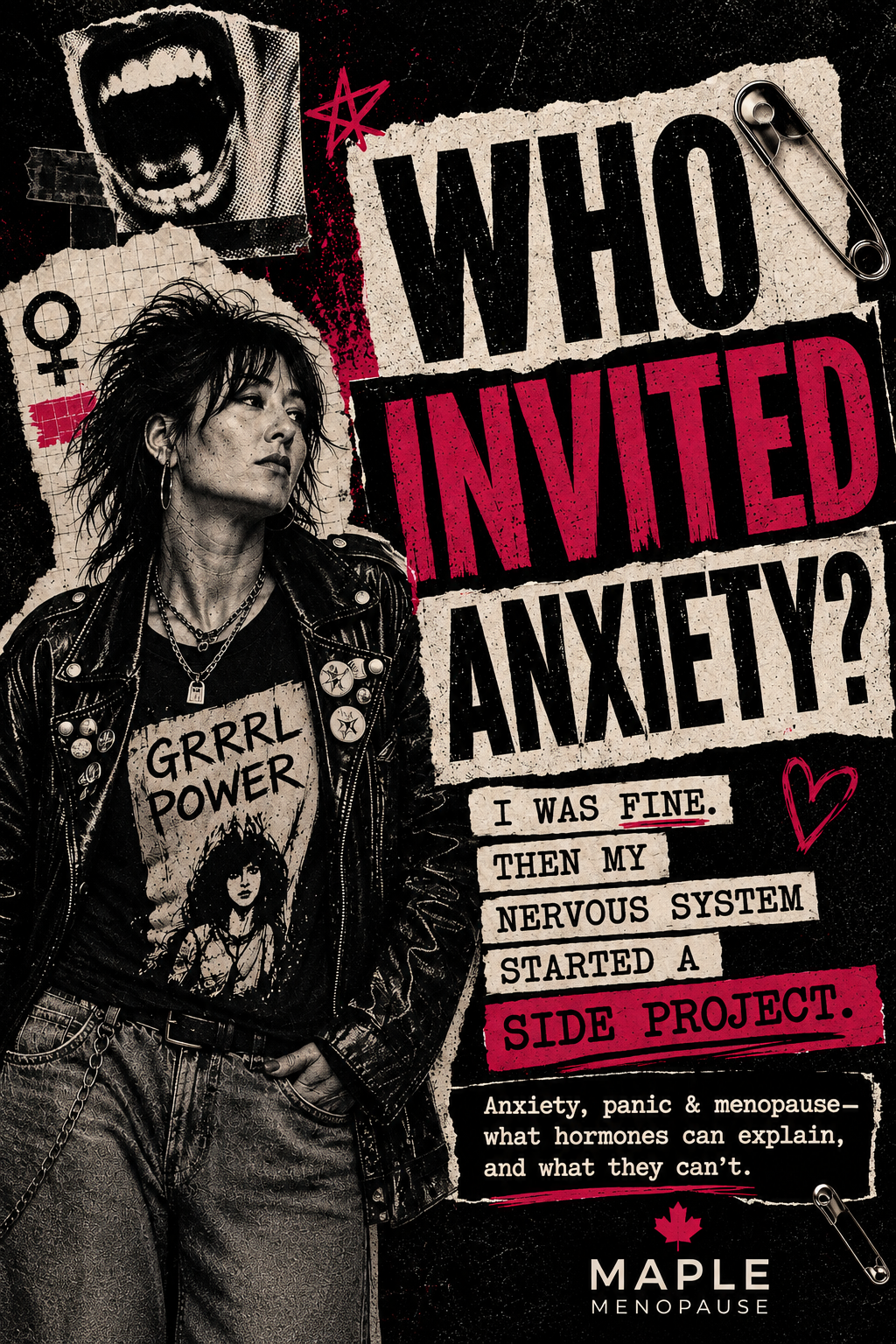
IN THIS ARTICLE
- A quick guide to what needs what
- Menopause and Anxiety: Why You May Suddenly Feel Unlike Yourself
- Why perimenopause may affect the brain
- When anxiety becomes panic
- CBT: considerably more than “think positive”
- A practical midlife anxiety plan
- Work, caregiving and the invisible load
- When to arrange care
- The Maple Menopause Bottom Line
- References & Further Reading
A quick guide to what needs what
| What is happening | A sensible next step |
|---|---|
| A familiar anxiety surge with no new warning signs | Slow the breathing, reduce stimulation and use the plan you have practised. |
| Persistent anxiety, panic, low mood or avoidance | Arrange a clinical assessment; CBT and medication are evidence-based options. |
| New chest pain, fainting, severe breathlessness or persistent palpitations | Seek prompt medical assessment rather than assuming menopause or panic. |
| Thoughts of suicide or immediate danger | In Canada, call or text 9-8-8; call 9-1-1 for immediate danger. |
Menopause and Anxiety: Why You May Suddenly Feel Unlike Yourself
Anxiety, irritability, low mood and emotional volatility can become more noticeable during the menopause transition. For some women, anxiety appears for the first time; for others, an existing tendency becomes harder to manage. Hormonal change may contribute, but menopause is rarely the only variable—and new or severe mental-health symptoms deserve the same careful assessment they would at any other stage of life.
One of the more unsettling experiences of perimenopause can be psychological rather than physical. A woman who has always considered herself calm may suddenly wake with a sense of dread. Someone who previously managed anxiety well may find that familiar coping strategies no longer seem sufficient. Irritability can feel disproportionate. Sleep disappears. Thoughts race. Ordinary work feels overwhelming. A first panic attack can arrive with a pounding heart, chest tightness, sweating and the frightening conviction that something is seriously wrong.
These experiences are real, but the explanation is more complicated than “your estrogen is low.” During perimenopause, ovarian hormone levels can fluctuate substantially before eventually settling at lower postmenopausal levels. At the same time, hot flashes, night sweats, insomnia, physical symptoms, caregiving, work, relationship changes and the accumulated pressures of midlife can interact with brain systems involved in mood and anxiety. Canadian menopause guidance recognizes mood changes, irritability and anxiety as part of the menopause transition, and the Canadian Menopause Society specifically addresses mood, sleep and cognition in its clinical guidelines.
The important message is not that menopause causes every episode of anxiety or depression. It is that the menopause transition may create a period of increased vulnerability—and symptoms deserve to be treated rather than dismissed as something women simply have to endure.
Why perimenopause may affect the brain
Estrogen is a reproductive hormone, but reproduction is far from its only biological role. Estrogen receptors are distributed throughout the brain, including regions involved in mood, cognition, temperature regulation and sleep. Estrogen also interacts with neurotransmitter systems including serotonin, dopamine and noradrenaline. Progesterone biology is relevant too: one of its metabolites, allopregnanolone, interacts with GABA-A receptors, part of the brain’s major inhibitory signalling system.
That creates a biologically plausible connection between fluctuating reproductive hormones and changes in mood or anxiety. But biologically plausible does not mean biologically simple. Perimenopause is often characterized by hormonal variability, not merely hormone deficiency, and psychological symptoms may reflect a combination of hormonal susceptibility, vasomotor symptoms, sleep disruption, previous mental-health history and current life stressors. A systematic review concluded that the menopause transition is associated with increased vulnerability to depression and anxiety, while also identifying previous depression and adverse life events as important contributors.
Depression risk appears to rise during perimenopause
Ordinary emotional fluctuation and major depressive disorder are not the same thing. A 2024 meta-analysis found that perimenopausal women had a significantly greater risk of depressive symptoms or diagnoses than premenopausal women, while the same increase was not clearly seen after menopause.
That does not mean most women will develop clinical depression. It means significant mood symptoms during the transition should not automatically be dismissed as “normal hormones.” Previous depression, anxiety or sensitivity to other reproductive hormone transitions may also be clinically useful context.
Anxiety can look surprisingly physical
Anxiety is not always experienced as conscious worrying. It can feel like a racing or pounding heart, chest tightness, trembling, nausea, dizziness, tingling, sweating, breathlessness, muscle tension, internal agitation, waking with a sense of dread or feeling unusually sensitive to noise and stimulation.
That overlap can be confusing because hot flashes themselves may involve sweating, palpitations and a sudden uncomfortable surge through the body. Canadian menopause guidance notes that anxiety and heart palpitations can accompany hot flashes.
If the brain interprets those sensations as danger, the physical symptoms can escalate further.
The hot-flash–anxiety feedback loop
Imagine waking at 3 a.m. suddenly hot, sweating and aware that your heart is pounding. Your brain asks, What’s wrong? That thought increases sympathetic nervous-system activation. Your heart beats faster. You notice it. You become more alarmed. Now you are completely awake.
Even after the hot flash ends, you may remain in bed monitoring your body and worrying about whether you will fall asleep again. The following day you are exhausted. By the next evening you are already anxious about bedtime.
This is how several menopause symptoms can become a self-reinforcing system rather than a collection of unrelated problems.
Sleep may be one of the biggest hidden drivers
Sleep deserves serious attention whenever anxiety escalates in midlife. Night sweats can repeatedly fragment sleep, and insomnia itself becomes more common during the menopause transition. Poor sleep can worsen emotional reactivity, concentration, irritability and anxiety, while anxiety makes sleep harder—a second feedback loop.
Canadian guidance specifically notes that night sweats can disrupt sleep and contribute to fatigue, irritability, concentration difficulty and mood changes.
If you are waking repeatedly because of vasomotor symptoms, treating those symptoms may help daytime mood and anxiety indirectly. If the hot flashes are controlled but insomnia continues, the insomnia may need its own treatment.
When anxiety becomes panic
A panic attack is a sudden surge of intense fear or discomfort with symptoms such as a racing heart, chest tightness, trembling, dizziness, air hunger or a sense that something terrible is happening. Panic disorder and agoraphobia are more specific clinical patterns; they are not interchangeable with ordinary worry or a single frightening episode.
For the fear-of-fear cycle, driving and sensory triggers, agoraphobic avoidance, panic-focused CBT and medication evidence, read When the Alarm Becomes a Siren: Menopause and Panic Attacks. New chest pain, fainting or significant breathlessness still needs medical assessment rather than an automatic panic label.
Palpitations are not automatically anxiety either
Palpitations can occur during the menopause transition and may accompany hot flashes or anxiety, but they also have other possible causes. Depending on the pattern and associated symptoms, a clinician may consider thyroid function, anemia, stimulant exposure, medications and heart rhythm problems.
Caffeine can contribute to palpitations and jitteriness in susceptible people. So can nicotine, some cold medications and certain supplements.
If the sensation is genuinely new, persistent or concerning, investigate it rather than simply assuming your nervous system has become dramatic.
Morning anxiety and the cortisol industry
Some women describe waking with an immediate surge of anxiety before they have even had time to think about anything.
Cortisol normally follows a circadian rhythm and rises around waking. That normal physiology has unfortunately been turned into a large online market for “cortisol detoxes,” adrenal-support products and hormone-balancing powders.
Persistent anxiety is not proof that your cortisol is toxic or your adrenal glands are exhausted.
Real disorders of cortisol production exist. They require medical diagnosis.
A social-media supplement stack does not diagnose or treat an endocrine disorder.
Rage and irritability count too
Not every mood change feels like sadness or fear. Some women describe a strikingly shorter emotional fuse during perimenopause. Minor frustrations suddenly provoke intense irritation or anger.
Hormonal change may contribute, but sleep deprivation, pain, chronic stress, relationship strain and constant responsibility can lower emotional tolerance too. The useful question is not whether every episode of irritability is pathological. It is whether it represents a meaningful change from your usual self and whether it is affecting work, relationships or your sense of control.
If it is, it deserves attention.
“I don’t feel like myself” is useful information
Women sometimes struggle to describe psychological changes because the experience does not fit neatly into a diagnosis. They may say:
I’m functioning, but everything is harder.
I can’t tolerate things the way I used to.
I feel constantly overwhelmed.
My confidence disappeared.
I don’t know why I’m anxious.
Those observations matter. But they still do not tell us why. Perimenopause can be relevant while generalized anxiety disorder, panic disorder, depression, ADHD, trauma, medication effects, thyroid disease, sleep disorders and overwhelming life circumstances remain possible contributors.
A useful assessment asks both:
Could menopause be contributing?
and
What else could be happening?
CBT: considerably more than “think positive”
Cognitive behavioural therapy (CBT) is one of the most established psychological treatments for anxiety and depression. Actual CBT is not a collection of positive-thinking slogans. It examines the relationships among thoughts, physiological sensations, emotions and behaviours and helps change patterns that maintain distress.
For panic, avoidance is particularly important. Someone who becomes frightened by a racing heart may stop exercising because exercise produces the same sensation. She may then avoid driving, shops, crowds or travel because she fears another panic attack somewhere she cannot immediately escape.
Avoidance provides short-term relief, but that relief teaches the brain that escaping was necessary.
Evidence-based panic treatment often includes exposure, gradually learning that feared sensations or situations can be experienced without catastrophe.
The vagus nerve: real anatomy, overworked marketing
The vagus nerve is the tenth cranial nerve and a major component of the parasympathetic nervous system. It carries signals between the brain and organs including the heart, lungs and digestive tract and participates in regulation of heart rate, digestion and other automatic functions.
That makes it relevant to the physiology of anxiety. Panic is intensely physical: breathing changes, heart rate rises, muscles tense and attention narrows toward perceived threat. Slow, controlled breathing can influence autonomic activity and help reduce physiological escalation.
But the internet has turned the vagus nerve into another wellness industry. You do not need to “reset” it, and not every cold plunge, humming exercise, ear gadget or neck stimulator advertised as vagal therapy has evidence behind it.
Some forms of vagus-nerve stimulation are legitimate medical treatments. That does not validate every consumer “vagus” product.
A very inexpensive starting point is simply slower breathing without hyperventilating. Breathe gently rather than taking enormous breaths, and if comfortable allow the exhalation to be somewhat longer than the inhalation.
Exercise has effects far beyond weight
Physical activity is frequently presented to midlife women primarily as a way to prevent weight gain. That undersells it.
Exercise can support mood, sleep, cardiovascular health, bone and muscle simultaneously. A 2024 meta-analysis of mind-body exercise in perimenopausal and postmenopausal women found improvements in anxiety, depression, sleep and several other outcomes, although specific interventions and study quality varied.
Walking, resistance training, yoga, cycling, swimming and other forms of movement can all contribute. It does not have to be punishing.
If anxiety makes exercise feel impossible, ten minutes still counts.
Alcohol can quietly worsen the situation
Alcohol may initially feel calming. The later effects can be quite different. It can fragment sleep and may worsen vasomotor symptoms and next-day anxiety in some people.
If anxiety has escalated, notice whether alcohol is helping for two hours and making the following twelve worse.
You do not necessarily need to make a permanent rule. An experiment—less alcohol for several weeks while observing sleep and anxiety—can give you useful information.
Caffeine deserves an experiment, not necessarily a lifetime ban
Caffeine is not inherently bad, but it can increase alertness, tremor, heart rate and jitteriness. Those sensations can be particularly unpleasant for someone already prone to panic or palpitations.
Try reducing the dose, moving it earlier in the day or replacing part of your intake with decaf for a few weeks.
Then see what happens to your sleep, anxiety and palpitations.
Antidepressants are not a failure to manage menopause “naturally”
SSRIs and SNRIs are established treatments for anxiety and depressive disorders. Some also reduce vasomotor symptoms, which means one medication may address more than one problem for certain women.
The appropriate medication depends on symptoms, health history, other drugs, previous treatment response, side effects and preference.
Medication is neither mandatory nor a failure.
A clinical anxiety disorder that happens to occur during perimenopause is still an anxiety disorder worth treating.
What about HRT?
Menopausal hormone therapy is not a universal anti-anxiety treatment or an antidepressant. Its clearest role is treatment of appropriate menopause symptoms, particularly bothersome vasomotor symptoms.
However, Canadian clinician guidance notes that hormone therapy may also improve associated problems including sleep disturbance and mood changes in appropriate patients.
Part of this may be indirect. If treatment stops severe night sweats, sleep can improve; better sleep can improve mood, concentration and anxiety.
There may also be direct neurobiological effects of reproductive hormones, and research continues into hormone therapy and perimenopausal depression. But someone with major depression, panic disorder or another psychiatric condition should not automatically substitute HRT for established mental-health treatment.
Sometimes both need attention.
What about supplements and calming teas?
Women commonly experiment with products such as L-theanine, magnesium, saffron, curcumin, ashwagandha and herbal “stress” teas. Some have interesting preliminary evidence; others are supported more by tradition or personal experience than by high-quality clinical trials. Research specifically in menopausal anxiety is much thinner than supplement advertising suggests. A systematic review of nutritional interventions for anxiety and mood symptoms around menopause concluded that the approaches are promising but that substantial heterogeneity and risk of bias make the true effects uncertain.
That does not mean every supplement is useless. It means possible benefit is not the same thing as established treatment.
We cover these separately in Supplements, Teas & Aromatherapy for Menopause Stress: What the Evidence Actually Says, including L-theanine, saffron, curcumin, magnesium, adaptogenic teas, lavender and the difference between a calming ritual and treatment for an anxiety disorder.
A practical midlife anxiety plan
1. Look for patterns. Track anxiety alongside sleep, menstrual changes if you are still cycling, hot flashes, alcohol, caffeine and medication changes for a few weeks.
2. Treat sleep as part of the problem. Address night sweats or other symptoms repeatedly waking you. Persistent insomnia may benefit from CBT-I.
3. Audit stimulants. Experiment with caffeine and review medications or supplements that may contribute to palpitations or jitteriness.
4. Move regularly. Think of activity as nervous-system and health maintenance rather than punishment for weight.
5. Learn an actual anxiety treatment. CBT, exposure-based treatment for panic and other evidence-based therapies have much stronger support than generic “self-care.”
6. Consider medication when appropriate. Significant anxiety or depression is treatable.
7. Look at menopause symptoms separately. If anxiety is occurring alongside disruptive hot flashes, night sweats or sleep problems, discuss whether menopause treatment is appropriate for the overall picture.
8. Treat optional supplements as optional. They should sit on top of an effective plan, not become the entire plan.
9. Reassess. If symptoms continue to worsen, do not simply keep adding supplements. Revisit the diagnosis.
Work, caregiving and the invisible load
There is another reason midlife mental health should not be reduced entirely to ovaries. For many women, perimenopause arrives during an extraordinarily demanding stage of life: established careers, financial responsibilities, teenagers or young-adult children, ageing parents, relationship changes and very little spare time for recovery.
Hormonal vulnerability can coexist with genuine overload.
Telling a woman in that situation simply to meditate more misses the point if nobody is willing to examine what she is carrying.
Sometimes the intervention is medical treatment. Sometimes it is therapy. Sometimes it is sleep. Sometimes it is redistributing work.
Usually it is more than one thing.
When to arrange care
Seek assessment when anxiety, panic or low mood is persistent, worsening, substantially interfering with work or relationships, causing increasing avoidance or making normal functioning difficult. New physical symptoms also deserve appropriate assessment rather than automatic attribution to menopause.
Depression requires particular attention when it includes profound hopelessness, inability to function, thoughts of death or self-harm, or the belief that others would be better off without you. Those symptoms require prompt professional help.
The Maple Menopause Bottom Line
Anxiety, panic, irritability and depressive symptoms can become more prominent during the menopause transition, particularly during perimenopause, when reproductive hormones are fluctuating. Current evidence supports increased vulnerability to mood and anxiety symptoms during this period, while sleep disruption, hot flashes, previous mental-health history and life circumstances can amplify the problem.
But “it’s hormones” should not become the new “it’s all in your head.”
A racing heart may be a hot flash, panic, medication effect or medical condition. Insomnia may be driven by night sweats, anxiety—or both. Depression occurring during perimenopause is still depression.
The useful approach is to treat the whole system: address disruptive menopause symptoms, protect sleep, reduce avoidable triggers, use evidence-based psychological treatment, use medication when appropriate, investigate symptoms that do not fit and treat supplements as optional additions rather than cures. If the dominant experience is loss of pleasure or motivation rather than fear, the anhedonia and apathy guide asks a different set of questions. If the distress is a broader sense of no longer recognizing yourself, start with identity loss in perimenopause and menopause.
References & Further Reading
Canadian Menopause Society — Menopause Symptoms Canadian Menopause Society
Canadian Menopause Society — Clinical Practice Guidelines Includes SOGC Guideline No. 422c: Menopause: Mood, Sleep and Cognition. Canadian Menopause Society Guidelines
Government of Canada — Women and Diversity Health Guide to Menopause Government of Canada Menopause Guide
Government of Canada — Medical Management of Menopause Symptoms Medical Management of Menopause
The Risk of Depression in the Menopausal Stages — Systematic Review and Meta-analysis (2024) PubMed
Does Menopause Elevate the Risk for Developing Depression and Anxiety? — Systematic Review (2023) PubMed
Effects of Nutritional Interventions on Mood and Anxiety Symptoms During the Menopausal Transition — Systematic Review PubMed
Effects of Mind-Body Exercise in Perimenopausal and Postmenopausal Women — Meta-analysis (2024) PubMed
Maple Menopause provides educational information and does not provide individualized medical advice, diagnosis or treatment.
Want the complementary-options reality check?
Read our evidence review of supplements, teas and aromatherapy, or browse the practical support-tool guide.