SYMPTOMS, IN PLAIN ENGLISH
Menopause symptoms: what can change—and when
IN THIS ARTICLE
- First, what stage are we talking about?
- Common symptoms, explained
- Periods and temperature
- Sleep, energy and mood
- Thinking and nervous-system changes
- Muscles, joints and body changes
- Vaginal, urinary and sexual changes
- Skin, hair, eyes and mouth
- Do not assume it is “just menopause”
- Three practical next steps
- Sources and review notes
First, what stage are we talking about?
The hormone picture: Estrogen, progesterone and testosterone are present throughout life, but their patterns change: during the reproductive years, estrogen and progesterone rise and fall with each menstrual cycle; in perimenopause those swings become less predictable; and after menopause both remain much lower. Testosterone—also made by women—usually declines more gradually across adulthood rather than dropping suddenly at menopause.
Perimenopause
Perimenopause is not a smooth, predictable decline. As the ovaries’ remaining egg supply gets lower, they may not release an egg every month as reliably as before. Estrogen can rise and fall sharply from one cycle to the next, while progesterone is often produced less consistently when ovulation does not occur. That variability helps explain why symptoms can feel intermittent or even contradictory.
Most women notice the transition in their 40s, although timing and duration vary. Periods may remain regular at first, then become shorter, longer, heavier, lighter or farther apart.
- You may still ovulate: pregnancy remains possible until menopause has been reached.
- Symptoms can precede obvious cycle changes: hot flashes, sleep problems, mood changes, brain fog, palpitations or vaginal symptoms may appear before periods stop.
- Bleeding still deserves context: very heavy bleeding, bleeding after sex or between periods, or another worrying change should be medically assessed rather than automatically blamed on hormones.
Menopause
Menopause is a milestone, not a long phase. It is identified retrospectively after 12 consecutive months without a menstrual period, when no other cause explains the absence. The average age in Canada is about 51.
By this point, the ovaries are no longer releasing eggs regularly and estrogen and progesterone settle at much lower levels. The brain, blood vessels, bones, muscles, genital tissues and urinary tract all respond to these hormonal changes, which is why the experience is broader than periods ending.
- A date, not an endpoint: symptoms do not necessarily stop at menopause and may continue afterward.
- Diagnosis is usually clinical: age, menstrual history and symptoms are often more informative than one hormone test; surgery or medications can obscure period-based timing.
- Earlier menopause matters: periods stopping before age 45 should be discussed with a clinician, and possible menopause before age 40 needs timely assessment.
Postmenopause
Postmenopause begins immediately after the menopause milestone and continues for the rest of life. Hormone levels are generally more stable than during perimenopause, but they remain lower than during the reproductive years.
For some women, hot flashes and sleep disruption ease. For others they persist. Vaginal and urinary symptoms may continue or become more noticeable because lower estrogen affects tissue thickness, elasticity and moisture.
- Genitourinary symptoms may persist: dryness, irritation, painful sex, urinary urgency and recurrent urinary infections can be ongoing—and treatable.
- Bone and muscle require attention: lower estrogen contributes to loss of bone mineral density and changes in muscle and body composition over time.
- Bleeding is not expected: any vaginal bleeding after menopause should be medically assessed.
Canadian reference: Definitions and average ages follow the Government of Canada’s Women and Diversity Health Guide to Menopause ↗.
Common symptoms, explained
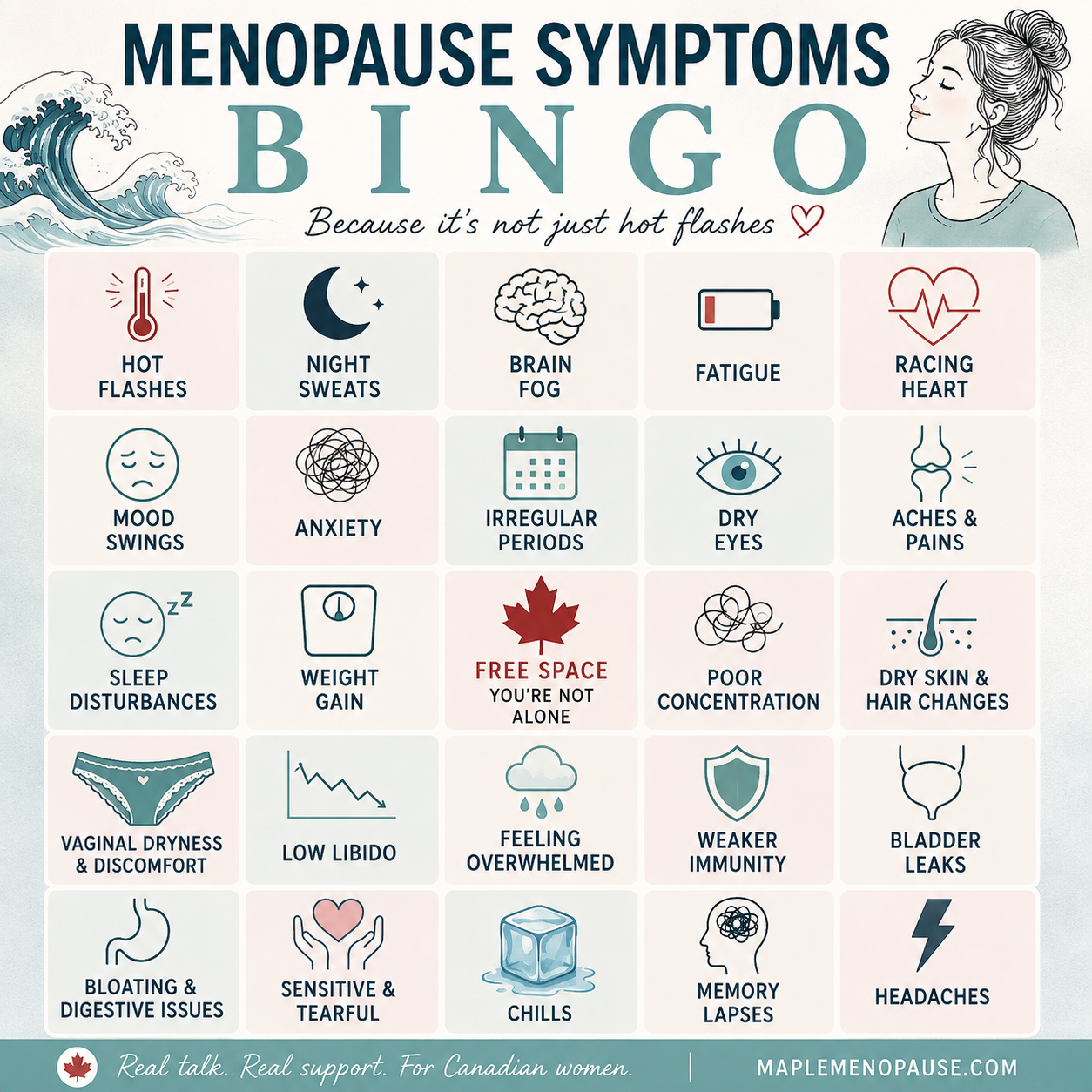
Perimenopause can affect much more than periods and temperature. Use this guide to understand common changes, notice patterns and decide what to discuss with a healthcare professional.
Important: A symptom can occur during menopause without being caused by menopause. New, persistent, severe or worrying symptoms still deserve medical assessment.
No one experiences every symptom. Some people have few changes; others have symptoms that disrupt sleep, work, relationships or daily life.
Periods & temperature · Sleep, energy & mood · Thinking & nervous system · Muscles & body · Vaginal, urinary & sexual · Skin, hair, eyes & mouth
Periods and temperature
These are among the most recognizable changes, but their timing and intensity vary widely.
Changes in periods
During perimenopause, cycles may become shorter, longer, closer together or farther apart. Flow may become lighter or heavier, and spotting can occur. Very heavy bleeding, bleeding after sex, bleeding between periods or any bleeding after menopause should be medically assessed.
Hot flashes
A hot flash is a sudden wave of heat, often felt in the face, neck or upper chest. It may bring flushing, sweating, chills, anxiety or a pounding heartbeat and can last from seconds to several minutes.
Night sweats
Night sweats are hot flashes that happen during sleep. They may range from feeling unusually warm to soaking sleepwear or bedding, and repeated episodes can leave you tired the next day.
Sleep, energy and mood
Hormonal fluctuation, interrupted sleep, pain and life stress can overlap, so it is often more useful to track patterns than to search for one cause.
Trouble sleeping
You may have difficulty falling asleep, wake repeatedly, or wake too early and be unable to return to sleep. Night sweats can contribute, but anxiety, depression, pain, medication effects and sleep apnea can also disturb sleep and may need separate attention.
Fatigue
Fatigue is more than ordinary sleepiness: it can feel like persistent physical or mental depletion. Poor sleep, pain and mood changes may contribute. Heavy bleeding can also cause iron-deficiency anemia, so ongoing fatigue should not automatically be attributed to menopause.
Mood swings and irritability
Emotions may feel less predictable or harder to regulate, particularly during perimenopause. Irritability, tearfulness or feeling overwhelmed can be intensified by hormonal fluctuation, poor sleep and life stress.
Anxiety
Anxiety may appear for the first time or become more noticeable. It can feel like constant worry, inner agitation, a sense of dread or physical symptoms such as tension and a racing heart. Sudden or severe symptoms still require assessment because thyroid, heart and other conditions can feel similar.
Low mood or depression
Some people experience reduced motivation, persistent sadness, loss of interest, hopelessness or changes in appetite and sleep. Perimenopause is a period of increased vulnerability to depression, but depression is a real health condition—not something to dismiss as “just hormones.”
Understand menopause-related sleep, fatigue and mood changes →
Thinking and nervous-system changes
Many people describe cognitive or sensory changes during the transition. New, progressive, severe or one-sided symptoms still require assessment.
Brain fog and difficulty concentrating
Brain fog may feel like slower thinking, distractibility, difficulty switching between tasks or trouble retrieving familiar words. These changes are commonly reported during perimenopause and often stabilize after menopause, but new or concerning cognitive changes should be discussed with a clinician.
Forgetfulness
You may misplace objects, forget why you entered a room or need more reminders than before. Sleep disruption, stress, depression, medication and other medical conditions can also affect memory.
Headaches and migraine changes
Headaches may become more frequent, and migraine patterns can change as hormones fluctuate—particularly during perimenopause. A sudden worst-ever headache, a new neurological symptom or a major change in an established headache pattern needs prompt medical attention.
Heart palpitations
Palpitations can feel like fluttering, pounding, racing or skipped heartbeats and may accompany a hot flash. Because heart rhythm problems, thyroid disease, anemia and other conditions can cause similar sensations, new or persistent palpitations should be assessed.
Tingling or altered skin sensations
Pins and needles, crawling sensations or unusual skin sensitivity are sometimes reported during the menopause transition. Persistent, one-sided, painful or weakness-associated symptoms require medical assessment rather than self-diagnosis.
Muscles, joints and body changes
Menopause occurs during the same years when aging, activity, sleep and health conditions can also affect strength, comfort and body composition.
Joint pain and stiffness
Joints may feel achy or stiff, especially after rest or on waking. Menopause may contribute to musculoskeletal discomfort, but swelling, redness, injury, persistent focal pain or loss of function may point to another cause.
Muscle aches, weakness or reduced strength
Some people notice more soreness, slower recovery or loss of strength. Muscle mass also tends to decline with age. Progressive resistance exercise, adequate nutrition and assessment of unexplained weakness can be important.
Bloating and body-composition changes
Bloating may become more noticeable during perimenopause. Aging, sleep, activity, medications and hormonal change can also shift where the body stores fat and how easily muscle is maintained. Persistent abdominal swelling, pain, feeling full very quickly or unexplained weight change should be assessed.
Vaginal, urinary and sexual changes
These symptoms are often grouped under genitourinary syndrome of menopause, or GSM. Unlike some perimenopause symptoms, they commonly persist or progress after menopause without treatment.
Vaginal dryness, burning or irritation
Lower estrogen levels can make vulvar and vaginal tissues thinner, drier and more sensitive. This may cause dryness, itching, burning, small tears or spotting. These symptoms are common and treatable; they do not need to be endured in silence.
Pain during sexual activity
Reduced moisture and tissue flexibility can make penetration uncomfortable or painful. Pain should not be accepted as an inevitable part of aging; infections, skin conditions, pelvic-floor problems and other causes may also need evaluation.
Urinary urgency and frequency
You may need to urinate more often, feel a sudden difficult-to-delay urge, or wake at night to urinate. Burning, fever, blood in the urine or new back pain may signal infection or another urinary problem and should be assessed.
Bladder leakage and recurrent urinary infections
Some people notice leakage with coughing, sneezing or exercise, while others leak after a sudden urge. Changes in urinary and vaginal tissues can also increase susceptibility to urinary tract infections. Pelvic-floor strengthening is not the right answer for every pelvic-floor condition, so persistent symptoms deserve individualized assessment.
Changes in sexual desire, arousal or orgasm
Interest in sex may decrease, increase or fluctuate. Hormones may play a role, but comfort, sleep, stress, medications, mood, relationship factors and general health also matter. Arousal may take longer and orgasm may feel different.
Skin, hair, eyes and mouth
Dryness and tissue changes can occur during the menopause years, but they are not specific enough to diagnose menopause on their own.
Skin changes
Skin may become drier, thinner, itchier or more sensitive as collagen and moisture change with age and lower estrogen levels. A new or changing mole, persistent rash or unexplained bruising is not a routine menopause symptom and should be assessed.
Hair changes
Hair may become drier, finer or less dense, and some people notice increased facial hair. Thyroid disease, iron deficiency, medications, genetics and other conditions can also contribute to hair loss.
Dry eyes, dry mouth or oral discomfort
Some people report dry or irritated eyes, mouth dryness, gum changes, altered taste or a burning sensation in the mouth or tongue. Because medications, autoimmune disease, dental conditions and other causes overlap, persistent symptoms deserve evaluation.
Read about menopause-related hair, skin, eye and mouth changes →
Do not assume it is “just menopause”
Seek urgent or emergency care for chest pain, difficulty breathing, fainting, signs of stroke, a sudden severe headache, thoughts of suicide or severe bleeding.
Arrange medical assessment for:
- Any bleeding after menopause
- Bleeding that is very heavy, prolonged, between periods or after sex
- A new breast lump, nipple discharge or skin change
- Persistent pelvic or abdominal pain, pressure or swelling
- Recurrent urinary symptoms, blood in the urine or fever
- New, severe, progressive or one-sided neurological symptoms
- Symptoms that interfere with sleep, work, relationships or normal daily functioning
Three practical next steps
Choose the tool that matches what you need now: record a pattern, prepare for a focused appointment, or find an appropriate route into Canadian care.
Sources and review notes
- Canadian Menopause Society: Definition and Stages ↗
- Canadian Menopause Society: Menopause Symptoms ↗
- HealthLink BC: Perimenopause ↗
- SOGC Menopause and U: Menopausal Symptoms ↗
Reviewed August 2026.