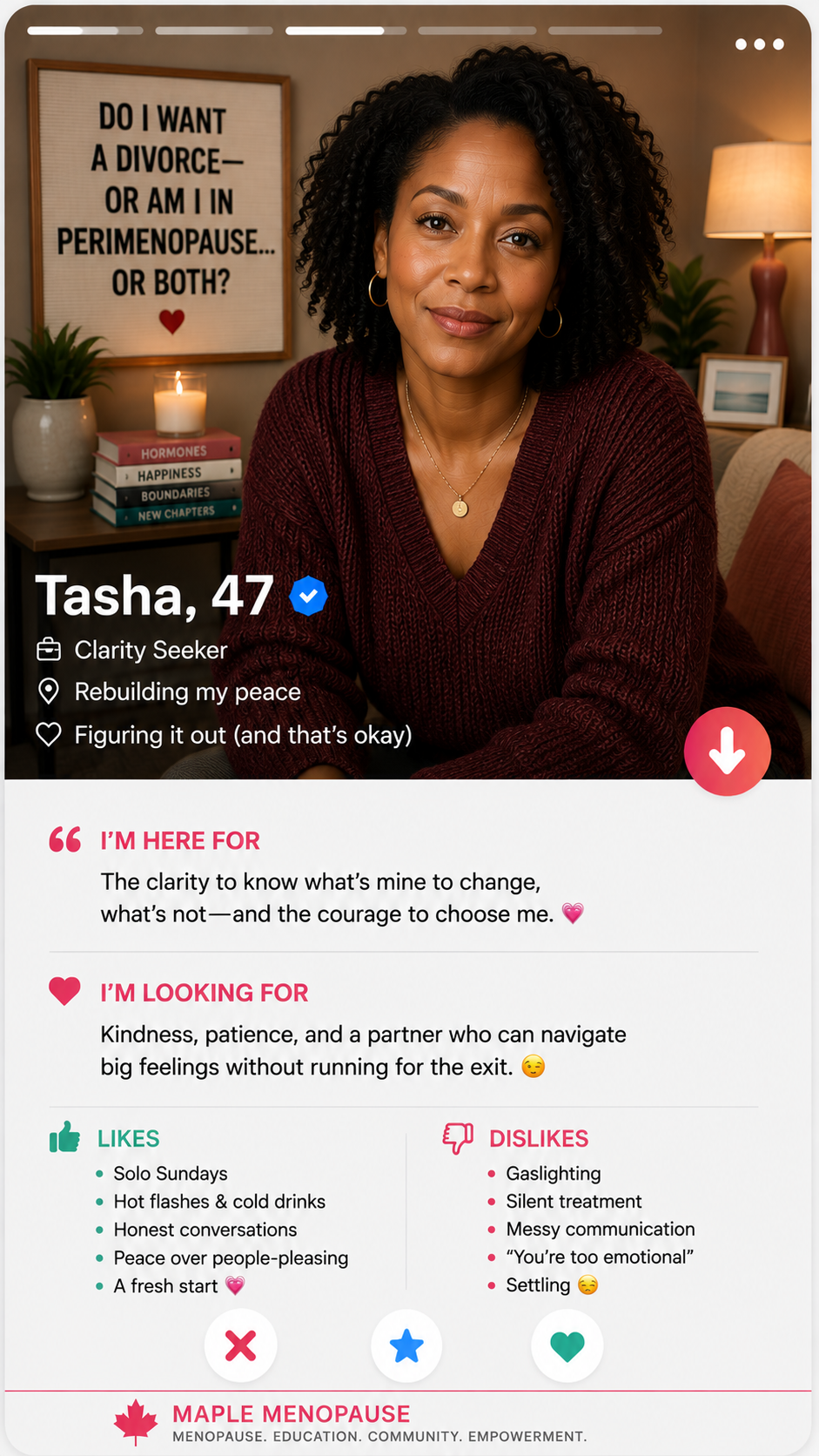
There is a particular kind of midlife panic in looking at a person you have loved for twenty years and wondering whether you want a divorce, a week alone in a quiet hotel, or simply for them to stop chewing cereal near you.
Perimenopause can affect sleep, anxiety, mood, stress tolerance, concentration, sexual desire and physical comfort. It also tends to arrive during careers, caregiving, aging parents, teenagers or adult children, financial pressure and the accumulated negotiations of a long relationship. Sometimes an ordinary irritation suddenly feels unbearable. Sometimes a woman stops pretending that something genuinely unbearable is ordinary.
Menopause may turn up the volume. It doesn’t necessarily write the song.
This article cannot tell you whether to stay or leave. It can help separate questions that are often mashed together: What is happening in my body? What is happening in my life? What is happening in this relationship? The answers may overlap without being identical.
IN THIS ARTICLE
- “I love him. I just want to live alone.”
- The disappearing tolerance for bullshit
- Sleep deprivation changes the relationship you experience
- Rage, irritability, anxiety and mood
- Why does my partner suddenly give me the ick?
- Sex is where everything collides
- “I cannot be the infrastructure anymore”
- The empty-nest reckoning
- Before you blame the hormones—or ignore them
- Some couples do get through a severe midlife crisis
- Hormone therapy is not marriage therapy
- Counselling can help—when the relationship is safe
- When the problem is bigger than perimenopause
- Do not create a “no major decisions during menopause” rule
- Sources and further reading
“I love him. I just want to live alone.”
A striking midlife fantasy is not necessarily another romance. It is an apartment with one mug in the sink. A cabin. A bed nobody enters without invitation. A whole Saturday during which nobody asks where the batteries are.
The fantasy deserves curiosity rather than an instant diagnosis. You may be imagining divorce, but you may also be imagining rest, autonomy, privacy, control over your time, freedom from touch, fewer caregiving demands or relief from managing another adult. If you still love your partner yet dream relentlessly of solitude, ask what the imagined home gives you that your current one does not.
The answer may suggest changes short of divorce: protected time alone, separate bedrooms, an equitable division of labour, a regular night away, less default availability or a partner taking complete ownership of responsibilities rather than “helping” after being assigned. It may also reveal that the life you want is incompatible with the marriage as it exists. Sometimes both are true.
The disappearing tolerance for bullshit
Many women describe becoming less willing in midlife to people-please, absorb everyone else’s moods or smooth over conflict. Some of that may reflect generalized irritability or reduced stress tolerance. Some reflects greater self-knowledge, financial independence, children needing less hands-on care, awareness that time is finite and exhaustion after decades of performing agreeableness.
A lower tolerance threshold can make you overreact to the dishwasher. It can also make you stop pretending that a twenty-year problem is fine. Those are not the same thing.
The difference is rarely found by asking whether anger is “hormonal.” Look at the subject, pattern and history. Are you furious with everyone, including people you usually like, or primarily with a partner who has ignored the same request for years? Does the reaction feel new and disproportionate, or has the grievance been present in old journals, repeated arguments and abandoned attempts at counselling?
Perimenopause does not create respect, contempt, fairness or betrayal. It can change the physical and emotional resources available for accommodating them. A woman who used to compensate for an unequal system may no longer be able—or willing—to keep it running.
Sleep deprivation changes the relationship you experience
Chronic poor sleep affects attention, memory, emotional regulation, anxiety, patience and the ability to recover after conflict. It can reduce desire and make ordinary demands feel like one demand too many. Night sweats can repeatedly fragment sleep, but pain, depression, anxiety, sleep apnea, caregiving and a partner’s snoring can also contribute.
Someone who has slept badly for six months may genuinely experience her marriage differently. That does not make the problems imaginary. It means the conversation is taking place in a brain and body working without adequate recovery.
If sleep deteriorated alongside hot flashes or cycle changes, our guide to menopause sleep problems explains what may help and what deserves assessment. Treating night sweats may improve sleep; persistent insomnia may need its own treatment. Better sleep can create more capacity for judgment and conflict resolution, but it cannot turn chronic disrespect into respect.
Rage, irritability, anxiety and mood
The menopause transition is a period of increased vulnerability to mood symptoms for some women, particularly those with previous depression or significant life stress. Hormonal variability, vasomotor symptoms and sleep disruption can interact, but there is no universal clinical condition called “menopause rage,” and estrogen does not provide a simple explanation for every outburst.
Anger is information, but it is not always a verdict. Feeling furious does not prove the marriage should end. Being perimenopausal does not make legitimate anger invalid either. If anxiety, low mood, irritability or a sense of not being yourself has become persistent or disruptive, our article on menopause, anxiety and panic covers evidence-based assessment and treatment.
New major depression, severe anxiety, escalating substance use, thoughts of self-harm or an inability to function needs prompt professional help. In Canada, call or text 9-8-8 for suicide-crisis support; call 9-1-1 for immediate danger. A mental-health condition occurring during perimenopause is still a health condition, not a character flaw or a relationship strategy.
Why does my partner suddenly give me the ick?
Loss of attraction can involve libido changes, sensory sensitivity, exhaustion, body image, sexual pain, medication effects or a changing identity. It can also be the erotic consequence of resentment. It is difficult to desire someone you experience as another dependent, particularly if you are planning their appointments, finding their belongings and carrying the household’s emotional weather.
Touch aversion deserves context. Does all touch feel unwelcome, or mainly touch that carries an expectation of sex? Is affection still pleasant when there is no pressure? Did attraction change with physical symptoms, or after years of unequal labour, sexual disappointment or emotional disconnection? Hormone therapy may help appropriate menopause symptoms; it cannot be expected to manufacture attraction to a particular person.
Sex is where everything collides
Desire may be high, low, fluctuating or responsive rather than spontaneous. Sexuality can be affected by fatigue, mood, medications, body image, relationship quality and what is actually happening in bed. Genitourinary syndrome of menopause (GSM) can cause dryness, burning, urinary symptoms and painful sex, while a partner may be dealing with erectile dysfunction, prostate treatment, diabetes, cardiovascular disease or medication effects.
A woman’s body is not marital property. Nobody owes sex to preserve a marriage, and pressure or coercion is not solved by lubricant or couples counselling. At the same time, losing a valued sexual relationship can cause genuine grief for both partners. Adults can acknowledge that loss without turning access to one person’s body into the solution.
Physical pain should be assessed and treated rather than endured. Lubricants, regular vaginal moisturizers and prescription GSM treatments—including low-dose vaginal estrogen for appropriate patients—have different roles. Our guide to hormone therapy in Canada explains those options, while Dating After 40 in Menopause offers a broader, sex-positive discussion of desire, intimacy and sex beyond penetration.
“I cannot be the infrastructure anymore”
Household labour is larger than cooking and cleaning. It includes noticing what is running out, booking appointments, remembering birthdays, buying gifts, tracking school forms, planning meals, arranging care, maintaining family relationships and noticing that another person needs emotional support before they ask. Much of this work remains invisible precisely because somebody does it before a problem appears.
Perimenopause may not create an unequal division of labour. It may make carrying it physically and emotionally harder. Brain fog, fatigue, heavy bleeding, poor sleep and caregiving overload collide badly with a household organized around one person remembering everything.
This is not a story in which all men are useless and all women are saints. The useful question is whether labour is genuinely equitable and whether both partners respond when circumstances change. “Tell me what to do” still leaves one person as project manager. Ownership means noticing, planning, executing and following through.
The empty-nest reckoning
When children begin leaving, a marriage becomes more visible as a relationship rather than primarily a parenting unit. Some couples rediscover each other. Others discover that logistics were the main thing they still shared, or that parenting had postponed conflicts nobody knew how to resolve.
This often occurs during the same years as perimenopause, but timing is not causation. A woman may also be grieving a role, caring for parents, reassessing work and wondering what she wants the next decades to contain. Wanting a different adulthood is not automatically a symptom.
Before you blame the hormones—or ignore them
Use these questions as prompts, not a scorecard:
- Did I feel this way before perimenopause, even if less intensely?
- Am I angry everywhere, or primarily with my partner?
- Does the relationship feel different after genuine rest or time alone?
- Is this ordinary irritation, or chronic disrespect, inequity or neglect?
- Have I repeatedly asked for something to change? What happened when I asked?
- Do I want my partner gone, or do I desperately want fewer demands?
- Is sex undesirable because of pain, fatigue, medication, resentment, relationship dynamics—or several of these?
- When I imagine leaving, what am I longing for: safety, peace, autonomy, sex, solitude, another relationship or a different identity?
- If my menopause symptoms improved dramatically tomorrow, which relationship problems would still exist?
Patterns are often more useful than a single terrible Tuesday. A private record of sleep, hot flashes, cycle changes, mood, conflict and time alone may help you notice whether distress rises everywhere at particular times or remains specific to recurring relationship events. Do not keep a record where an unsafe partner can find it.
Some couples do get through a severe midlife crisis
Not every relationship strained by perimenopause ends. Couples sometimes find that treating severe symptoms, improving sleep, addressing painful sex, redistributing labour and understanding desire changes gives them enough capacity to meet each other again. A partner who learns about menopause, listens without making every symptom about themselves and takes real ownership at home can materially change daily life.
When both people are fundamentally safe and want the relationship, useful options may include individual therapy, couples therapy, temporary space, protected solitude, reduced caregiving burden and frank conversations about sex. The measure is not whether everyone communicates beautifully in a counselling room. It is whether behaviour changes outside it.
There is no guarantee. Symptoms may improve and a woman may still want to leave. A couple may do thoughtful work and discover they want incompatible lives. Treatment can clarify the picture without dictating the answer.
Hormone therapy is not marriage therapy
For an appropriate patient, menopausal hormone therapy can reduce bothersome hot flashes and night sweats and may improve sleep when vasomotor symptoms are disrupting it. Local vaginal treatments can improve GSM. Mood and anxiety symptoms may require their own assessment and treatment; hormone therapy does not consistently relieve anxiety and is not a universal antidepressant.
Hormone therapy cannot create respect, redistribute domestic labour, repair betrayal, cure incompatibility or make an abusive relationship safe. It cannot make an unequal marriage equal.
That does not make symptom treatment irrelevant. Feeling less exhausted, panicked or physically uncomfortable can change how much capacity you have to think, communicate and choose. It simply should not be sold as a marital conversion kit.
Counselling can help—when the relationship is safe
Couples counselling may help two safe people understand a change in their relationship, improve conflict patterns and negotiate sex, labour and space. Individual therapy can help separate menopause symptoms, burnout, grief and relationship history while clarifying what you want. Neither form of therapy should be used to pressure someone to preserve a marriage.
Couples counselling is not the default when there is coercive control, intimidation, fear, sexual coercion, serious financial control, threats or violence. Better communication does not fix abuse, and joint sessions can increase risk or give an abusive partner more information to use. Seek confidential support and individualized safety planning instead.
When the problem is bigger than perimenopause
Violence, coercive control, sexual pressure, chronic degradation, intimidation, stalking, financial abuse, threats, isolation and fear should never be waved away as hormones. Repeated betrayal without repair, addiction harming the household and entrenched contempt are also relationship problems in their own right.
If you are in immediate danger in Canada, call 9-1-1. The Government of Canada’s family-violence services directory lists national, provincial and territorial resources, and ShelterSafe can help locate nearby shelters. If a partner may monitor your devices, use a safer device when possible and consider digital safety as part of safety planning.
Do not create a “no major decisions during menopause” rule
“Do not make major decisions while hormonal” sounds cautious until you remember that perimenopause can last years. It can become a tidy way to dismiss a woman’s judgment and keep her indefinitely inside a life she does not want.
When a relationship is safe and someone is in an acute crisis, it may be sensible to treat severe symptoms, seek sleep and support, gather financial or legal information, and avoid an unnecessarily impulsive irreversible act. That is deliberation. It is not a declaration of hormonal incompetence.
Take the symptoms seriously. Take your judgment seriously too.
Maybe perimenopause has made your partner chewing cereal sound like an act of psychological warfare. Maybe it has also made you realize you have been asking for the same basic respect since 2008. Both things can be true.
Treat the symptoms that need treating. Get sleep where possible. Address GSM and sexual pain. Seek assessment for depression or anxiety. Ask for help, revisit the division of labour and talk honestly about sex. Consider counselling when it is appropriate and safe. Then look at the relationship itself.
If the symptoms improved tomorrow, would you still want to leave?
You do not have to know immediately. You are allowed to ask.
Sources and further reading
- Canadian Menopause Society: Clinical Practice Guidelines
- Society of Obstetricians and Gynaecologists of Canada: Menopause
- The Menopause Society: Mental Health
- The Menopause Society: Hormone Therapy
- The Menopause Society: Sexual Health
- Association between menopausal symptoms and relationship distress
- Government of Canada: Family violence helplines and services
This article provides general education, not a diagnosis or individual medical, legal or relationship advice. Seek appropriate professional support for severe symptoms, safety concerns or major legal and financial decisions.