
Your social circle may be smaller at 50 than it was at 30. That can hurt. It can also leave room for friendships that fit the person you are now.
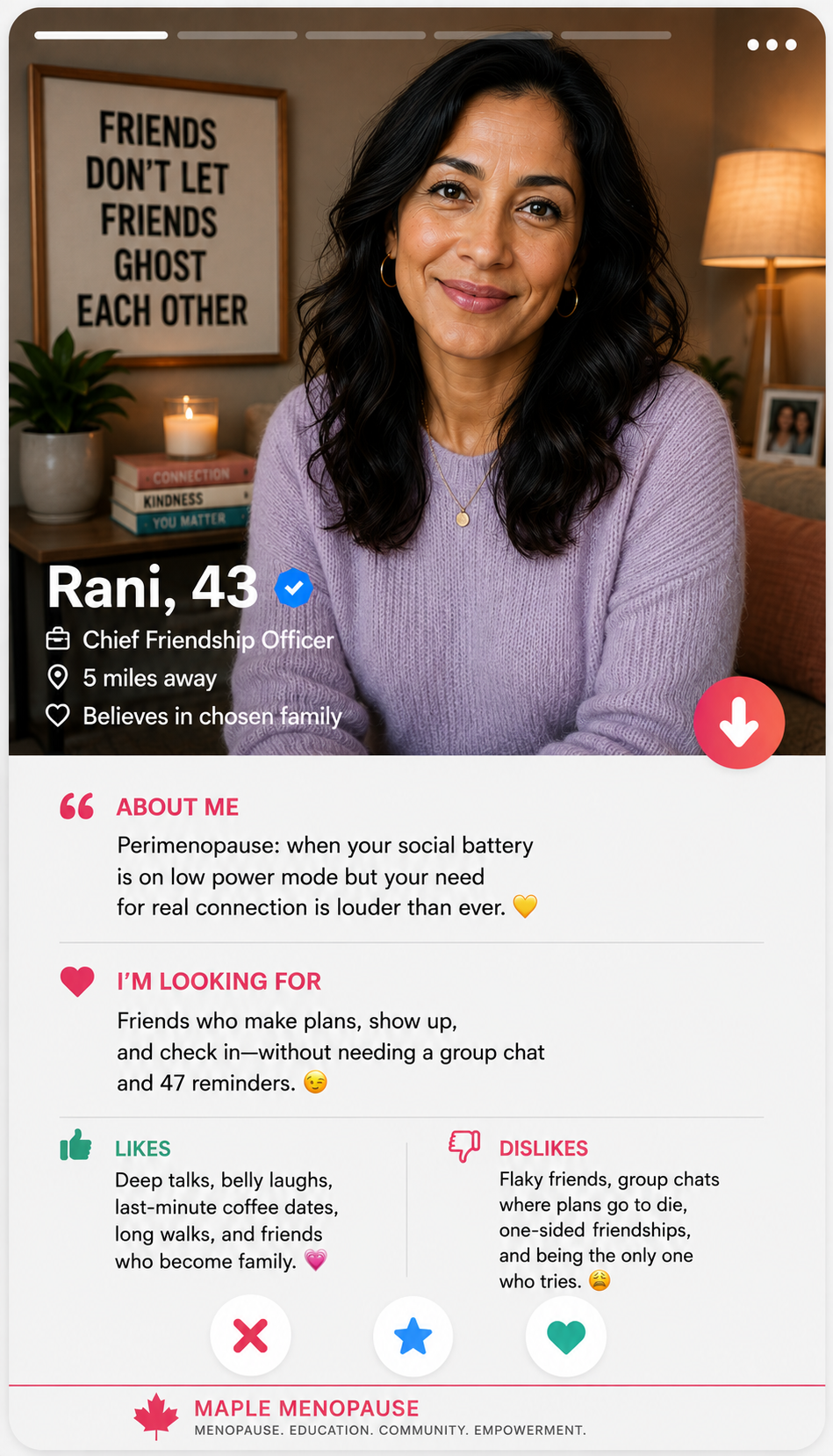
At some point, you may look up and wonder where everybody went. The women who once occupied whole weekends now appear in a birthday text and an annual lunch that takes six weeks to schedule. The school-gate crowd vanished when the children stopped needing gates. A work friendship did not survive remote work, a divorce reorganized the couples you knew, and somebody moved three provinces away.
No single event ended your social life. The infrastructure quietly came apart.
That can feel like loss because it is loss. It can also feel like relief if some relationships had become obligations held together by history and calendar notifications. A smaller circle may mean loneliness, selectivity, peace or all three on different Tuesdays.
IN THIS ARTICLE
- Loneliness is not a head count
- Chosen solitude does not need treatment
- When the infrastructure disappears
- History is not the same as compatibility
- Sometimes both women are drowning
- Friendship breakups are real grief
- The conditions where friendship can grow
- Treat friendship a little like dating
- Online friendship is real friendship
- Do not wait for a sitcom
- Starting fresh has one peculiar advantage
Loneliness is not a head count
The World Health Organization distinguishes loneliness from social isolation. Social isolation is the objective state of having too few relationships or interactions. Loneliness is the distressing feeling that your actual connections do not match the ones you want or need.
This is why a woman can know dozens of people and feel profoundly lonely, while another can spend Friday night reading alone and feel perfectly content. Statistics Canada found in 2021 that about 10% of Canadians aged 45 to 64 reported always or often feeling lonely. That is meaningful, but it is not evidence that midlife is a universal social wasteland.
Chronic loneliness and social isolation are associated with poorer physical and mental health, although association is not the same as a simple one-way cause. Social connection has structure, function and quality: how many relationships you have, what support moves through them and whether they feel satisfying or strained. Friendship research likewise suggests that quality matters, not only quantity.
The useful question is not “Do I have enough friends?” according to an imaginary national quota. It is: does the quiet feel like peace or absence?
Chosen solitude does not need treatment
Some women genuinely want more time alone in midlife. After decades of workplaces, family schedules and being continuously reachable, an evening with a book can feel restorative rather than bleak. Going to a film alone is not proof that your social life has failed, and having two friends instead of 12 is not automatically a problem.
Notice what solitude does to you. Peace tends to leave you restored and still able to reach toward people when you want them. Loneliness feels more like exclusion, disconnection or the absence of someone to call. The distinction can shift: a quiet weekend may be exactly what you need, while months of unwanted quiet may become painful.
If loneliness is persistent and arriving with depression, severe anxiety, hopelessness or loss of function, it is reasonable to seek help. A therapist cannot order a best friend from a catalogue, but support can address depression, social anxiety, grief or avoidance that makes connection harder. Structural barriers such as disability, money, transportation and caregiving also matter; loneliness is not always solved by trying harder.
When the infrastructure disappears
Many friendships are partly built by institutions. School supplied years of proximity. Early jobs put the same people near the coffee machine five days a week. Children generated playgroups, practices and a steady supply of other adults waiting in plastic chairs.
When the structure ends, a friendship may weaken even if nobody did anything wrong. Work changes. Children grow up. Neighbours move. Caregiving, illness and financial pressure consume the hours once available for dinner.
These were not fake friendships. A friendship can be completely genuine for the chapter in which it existed. It does not have to last until one of you dies to have mattered.
Midlife can remove several structures at once. An empty nest changes who you see; divorce may split a shared network; remote work eliminates casual contact. Menopause symptoms can reduce social capacity indirectly when poor sleep, fatigue or anxiety make an evening out feel like advanced logistics. That does not mean menopause biologically makes women dislike their friends.
History is not the same as compatibility
Someone may have known you since 1989 and no longer be someone you particularly enjoy. History can create tenderness, loyalty and a shorthand no newer person can reproduce. It can also keep two people performing roles that stopped fitting years ago.
This is not an invitation to sort everyone into internet categories of “toxic” and “healed.” Friendship involves generosity, forgiveness, occasional inconvenience and showing up when the other person is not sparkling company. The better question is about the pattern: can both people have needs, say no, disagree and adapt when circumstances change?
The midlife tolerance shift may make a one-sided pattern harder to ignore. That can be clarifying, but exhaustion and irritability can distort judgment too. Before ending a valued friendship, it is worth distinguishing a durable pattern from one difficult season.
Sometimes both women are drowning
Not every fading friendship has a villain. Sometimes both women are managing aging parents, illness, work trouble, divorce, grief or their own bodies behaving unpredictably. Each is waiting for the other to call while barely managing to answer messages.
A friendship may need to become lighter rather than end: a short text, a walk instead of dinner, an honest “I have very little capacity, but I have not forgotten you.” Reduced contact is not always reduced care.
Reciprocity still matters. If you are always the one remembering, arranging, listening and repairing, the imbalance is useful information. But look at the whole relationship, not only the month when somebody’s life caught fire.
Friendship breakups are real grief
Romantic breakups come with recognized scripts. People bring food, change their relationship status and understand why certain songs are temporarily forbidden. Friendship breakups often happen in near silence.
You may lose someone who knew you through a marriage, two careers, children, sick parents and decades of uneventful Thursdays. There may be no ceremony and no socially approved period in which you are allowed to be devastated.
You can miss someone and still know the friendship should not resume. You also do not need to rewrite 20 good years because year 21 ended badly. Grief can hold both the value of what happened and the truth that it is over.
Ambiguous endings can be especially difficult. Some friendships never receive a final conversation; messages simply become less frequent until neither person is quite sure whether the friendship still exists. You may decide to make one clear, low-pressure attempt to reconnect. If it is repeatedly unanswered, accepting the answer may be kinder than performing endless forensic analysis on the last text exchange.
The conditions where friendship can grow
Mutual interest + repeated contact + time + a little initiative = the conditions where friendship can grow.
This is an editorial framework, not a scientifically validated equation. It is useful because adult friendship often feels mysterious when the basic ingredients have simply become scarce.
Mutual interest gives two people a reason to enjoy each other. It may be shared humour, curiosity, values or simply liking how conversation feels. Repeated contact creates familiarity. School once supplied it automatically; in midlife, you may have to choose a place and keep returning.
Time allows trust to accumulate. One pleasant conversation produces a pleasant acquaintance, not an emergency contact. Then comes a little initiative, because friendship cannot grow indefinitely inside a pottery studio unless somebody eventually says, “Would you like coffee?”
The equation has limits. You cannot manufacture chemistry, and you cannot force reciprocity. If every invitation and follow-up comes from you, that does not necessarily mean rejection, but it is information about the relationship available.
Treat friendship a little like dating
People seeking romantic partners generally understand that they may need to go where potential partners are, meet more than one person, make plans and tolerate uncertainty. Adult friendship deserves some of the same intentionality, without the terrible profile photographs.
If friendship matters, it may need actual space in your calendar. You may have to show up when staying home sounds easier and risk the tiny vulnerability of asking someone for coffee. Some pleasant people will remain pleasant people. That is normal, not evidence that you are unfriendable.
Start with what you genuinely like doing. Do not join pickleball because someone declared it the official friendship distribution centre for women over 50 if you hate pickleball. Choose something that would add value to your life even if no friendship emerges.
A recurring art, pottery or language class creates natural repetition. Walking and hiking groups make conversation easier because you are side by side and already doing something. A local Meetup can work for the same reason, but one event is an audition for familiarity, not proof that Meetup “works” or does not.
Recurring volunteer work provides shared purpose and conversation, while regular involvement at a library, gallery, museum or community organization lets faces become familiar over time. The recurring part matters more than collecting unrelated events. Friendship is more likely to develop from seeing the same six people on Tuesday nights than six hundred people once.
Online friendship is real friendship
A person who lives 2,000 kilometres away but knows your life, remembers important dates and notices when you disappear can be a genuine friend. Geography does not decide whether care is real.
Research on digital connection is mixed because “online interaction” covers everything from intimate conversation to hostile scrolling. Reviews suggest technology can support connection for some people, but results vary by context and online support does not provide every kind of practical help. Your online friend cannot drive you home after a procedure if she lives in Halifax and you live in Calgary. She may still be the person you most need to talk to afterward.
Different relationships can meet different needs. One person does not have to be your confidante, walking partner, travel companion, emergency contact and fellow scholar of a niche television show. A close friend, an online friend and a neighbour you enjoy talking with can all count. Lighter relationships are not failed friendships.
Do not wait for a sitcom
Popular images of female friendship tend to arrive as a complete cast: brunch tables, group chats and coordinated trips. A realistic midlife network may be one close friend, a few activity acquaintances, an online friend, a neighbour and somebody from a class who is gradually becoming more familiar.
That counts. A network can be varied, quiet and spread across geography. It can also change after divorce in perimenopause or other upheaval without being rebuilt in the same shape.
Starting fresh has one peculiar advantage
A new friend does not know who you used to be. She does not know that you were always the organizer, the responsible one or the person expected to listen for three hours. She meets you now.
That can matter when you are already asking why you do not feel like yourself. New friendships can be built around the life you currently want: perhaps a Saturday walk, an art class and coffee that ends after an hour because both people have things to do.
There is no friendship vending machine. You can create conditions; you cannot guarantee an outcome. Some attempts will be awkward, some people will not reciprocate and some new connections will remain acquaintances.
Still, the framework remains useful: choose something you actually enjoy, go where other people do it and return. Learn a few names. Talk to someone. Eventually ask if she wants coffee. Give it time.
Occasionally, the person you met because you both kept showing up on Tuesday becomes the person you call five years later when something wonderful or terrible happens. That is how friendship has always worked. Institutions once arranged much of the repetition for us; now we may have to arrange it ourselves.
Your circle getting smaller does not necessarily mean your social life is ending. Sometimes it simply reveals whether the quiet feels like peace or absence—and what, if anything, you want to do next.
Sources and further reading
- World Health Organization: Social connection
- Statistics Canada: Loneliness in Canada
- Adult friendship and wellbeing: a systematic review
- Interventions to improve social connections: systematic review and meta-analysis
- Digital technology and social connectedness: systematic review
This article is for education and does not replace individualized mental-health or medical care.