Hair changes are common in midlife, but “menopause hair” is not one diagnosis. Thinning, shedding, breakage, dryness and greying can have different causes—and need different solutions.
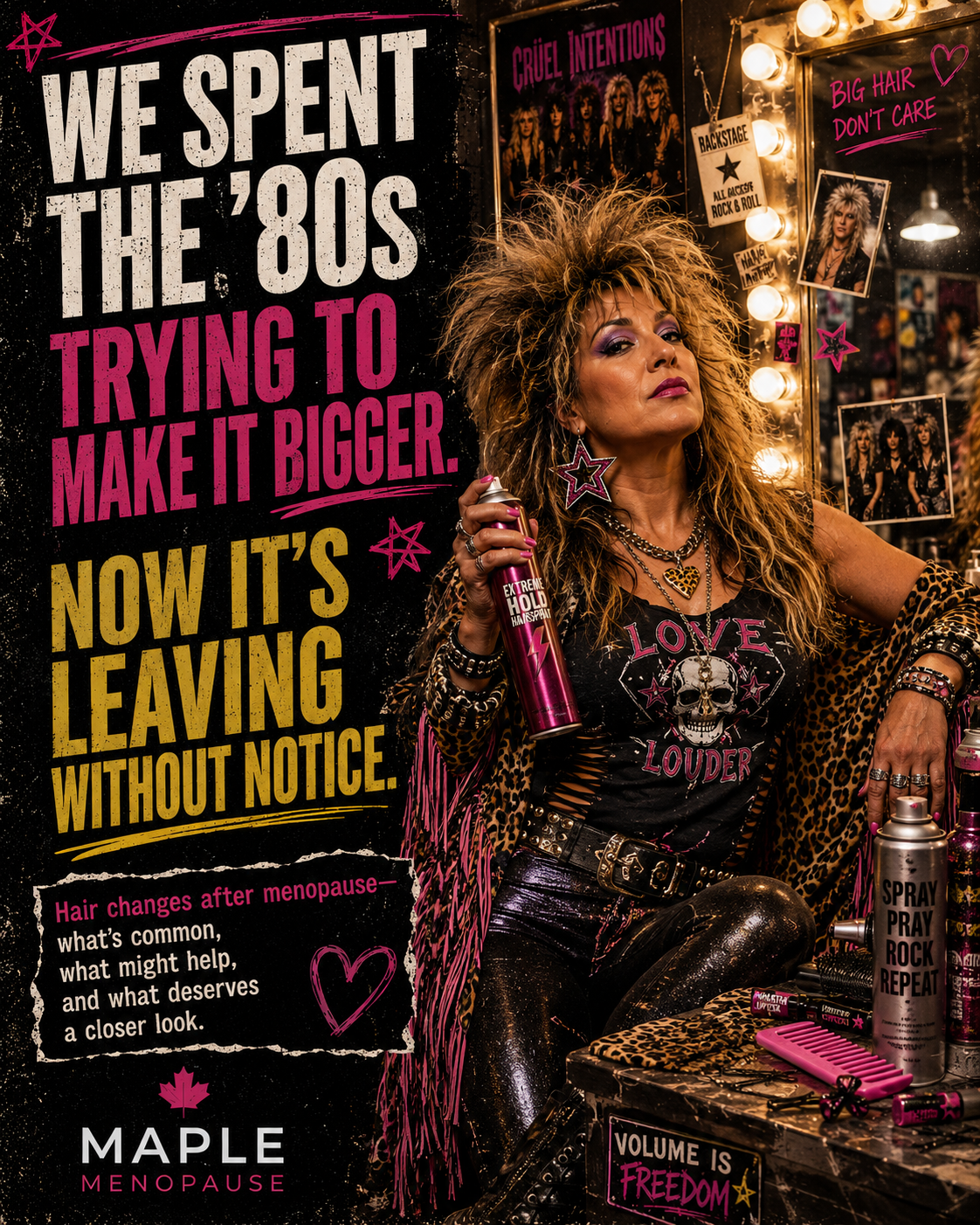
For some women, one of the stranger parts of midlife is realizing that the hair they have understood for decades suddenly behaves like somebody else’s. A ponytail becomes smaller. The part looks wider in photographs. More hair appears in the shower drain. Straight hair develops waves, curls become less predictable, or once-glossy hair becomes dry, coarse and prone to frizz. Grey and white hairs may add another texture to the mix.
It is tempting to call all of this “menopause hair.” Hormonal change may contribute, but that phrase can conceal different problems. Female-pattern hair loss, temporary excessive shedding, breakage, scalp disease, nutritional deficiencies and age-related changes in the fibre can look surprisingly similar in the mirror. The distinction matters: volumizing shampoo can make fine hair look fuller but cannot reverse follicular miniaturization, while hair-loss medication will not repair a shaft snapping from bleach and heat.
The first question is not “What menopause hair product should I buy?” It is “What is actually changing?”
IN THIS ARTICLE
- Hair is alive at the root—but not along the strand
- So what does menopause actually do to hair?
- Female-pattern hair loss: when the part keeps widening
- Then there is shedding: telogen effluvium
- Hair loss and hair breakage are not the same
- Why hair can suddenly feel dry, coarse or frizzy
- Grey and white hair deserve their own strategy
- Do not automatically blame menopause: medical causes matter
- Minoxidil: the treatment with the strongest track record
- Does HRT regrow hair?
- Popular treatments: promise versus evidence
- A practical menopause-hair plan
- When to see a doctor or dermatologist
- The Maple Menopause bottom line
- References and further reading
Hair is alive at the root—but not along the strand
The follicle is a living mini-organ embedded in the skin. Cells inside it produce the hair shaft. Once that shaft emerges above the skin, however, it is essentially keratinized tissue. Conditioner can smooth it, reduce friction and protect it from damage, but it cannot biologically feed a visible strand back to health.
Each follicle cycles through an active growth phase, a short transition and a resting phase before the old hair sheds. Some daily shedding is normal. What matters more is a change from your normal: dramatically more hair coming out, a progressively wider part, visible scalp, a shrinking ponytail, distinct bald patches or a receding hairline.
So what does menopause actually do to hair?
Hair thinning is recognized as a change that can occur during the menopause transition. But menopause symptoms overlap with other conditions, so a new hair problem should not automatically be attributed to falling estrogen.
Hair follicles respond to complex hormonal signals. Research suggests estradiol can influence growth and cycling, but the biology is more complicated than “estrogen falls, therefore hair falls out.” Reviews describe interactions among estrogen, progesterone, androgen signalling, ageing, genetics and environmental influences. Researchers still cannot neatly separate all of these effects.
Female-pattern hair loss becomes more common after menopause, suggesting hormonal change may contribute. Even here, the role of estrogen remains uncertain and most affected women do not have abnormally high circulating androgen levels. Chronological ageing is happening at the same time: follicles may produce finer fibres, density may decline, scalp oil can change, and decades of colouring, heat, UV and mechanical damage become more visible. Menopause may be part of the story without being the whole story.
Female-pattern hair loss: when the part keeps widening
Female-pattern hair loss (FPHL) is the most common cause of hair loss in women. It often becomes apparent in midlife, is progressive and has a strong genetic component that can come from either side of the family.
Instead of the classic baldness pattern many associate with men, follicles gradually miniaturize and produce finer, shorter hairs. Density falls most noticeably across the top of the scalp and centre part.
- The centre part becomes wider
- More scalp shows under overhead lighting
- The ponytail becomes smaller
- Density decreases over the crown
- Finer, shorter hairs replace previously thicker ones
FPHL is progressive, so recognizing it early matters. The American Academy of Dermatology notes that treatment tends to work best when started at the first signs of loss.
Then there is shedding: telogen effluvium
Telogen effluvium is different. An unusually large number of hairs enter resting and shedding stages around the same time, producing diffuse shedding rather than a slowly widening part. Triggers can include major illness or fever, surgery, severe stress, rapid weight loss, restrictive dieting, nutritional deficiency, thyroid disturbance and some medications.
Shedding can begin weeks or months after the trigger. In midlife, several triggers may overlap: disruptive symptoms, poor sleep, major stress, an aggressive diet and rapid weight loss. And telogen effluvium and FPHL can occur together. Distinguishing them matters because management differs.
Hair loss and hair breakage are not the same
Hair loss occurs when hair leaves the follicle. Breakage occurs when the shaft snaps along its length. Bleaching, colouring, chemical straightening, high heat, tight styles, rough detangling and accumulated mechanical damage weaken the fibre. Short broken pieces and ragged, thinning ends with relatively stable scalp density point toward breakage.
Conditioners, masks, leave-ins and some bond-building products can help reduce friction and further breakage. They do not treat follicular hair loss. A product that makes existing hair look thicker or smoother is not necessarily growing hair—and that is fine when the claim is honest.
Hair texture can change alongside broader dryness in midlife. The separate guide When Everything Feels Drier explains why skin, eyes and mouth may also need their own assessment rather than one catch-all menopause explanation.
Why hair can suddenly feel dry, coarse or frizzy
Texture depends on fibre diameter and geometry, follicle shape, sebum distribution, humidity, chemical processing, heat, ultraviolet exposure and mechanical damage. Midlife hair may become finer while feeling rougher. Grey hair adds another variable, and colouring or lightening grey lengths can compound dryness and porosity.
For curly and wavy hair, reduced lubrication can be particularly noticeable because scalp oils do not travel down bends as readily. This is where cosmetics can genuinely help. Conditioner, leave-in treatment, heat protectant and appropriate styling products can reduce friction, improve manageability and protect hair that now needs different care.
Grey and white hair deserve their own strategy
Greying primarily reflects declining pigment production in the follicle, with genetics strongly influencing timing. Purple and silver shampoos work by colour correction: violet pigment visually counteracts yellow tones. They do not reverse grey hair, repair follicles or make hair biologically healthier. For the distinct texture, identity and transition questions, see Silver, Shedding and the Scalp.
More is not necessarily better. Highly pigmented shampoo used too often can leave porous white or bleached hair dull, violet-tinged or dry. If the colour looks good but the fibre feels terrible, one problem has been traded for another.
Do not automatically blame menopause: medical causes matter
Hair loss can also be associated with thyroid disease, iron deficiency, inadequate energy or protein intake, rapid weight loss, illness, surgery, prolonged stress, medications, autoimmune disorders, scalp inflammation or infection, and chronic traction from tight hairstyles. A clinician may choose tests based on the pattern, history, diet, symptoms and examination; there is no universal “menopause hair-loss blood panel” everyone needs.
Investigate when appropriate rather than supplement blindly.
Biotin deserves considerably less hype
True biotin deficiency is uncommon in people eating a typical mixed diet. Correcting a real deficiency matters; taking more when you already have enough does not necessarily grow more hair. High-dose biotin can also interfere with some laboratory tests and produce misleading results.
Protein matters—but hair is not a reason to live on shakes
Inadequate nutrition can contribute to shedding, and severe restriction or rapid weight loss is particularly relevant. But once energy and protein needs are met, dramatically more protein does not guarantee dramatically more hair. Aggressive dieting while trying to preserve muscle, bone and hair can be a poor trade. Read Protein After 40 and The Midlife Metabolic Shift.
Minoxidil: the treatment with the strongest track record
For FPHL, topical minoxidil remains the most established non-prescription treatment and is the AAD’s most-recommended option. It is not instant: continuous use for roughly six to twelve months may be needed to judge the response.
Some users notice temporarily increased shedding during the first two to eight weeks as follicles transition through their cycles. If it works, continued treatment is generally required to maintain benefit. Potential adverse effects include scalp irritation and unwanted hair on the forehead or face. Pregnancy and breastfeeding considerations matter. Ask a pharmacist or clinician whether a product is appropriate for you and follow its Canadian label.
Minoxidil belongs in the treatment discussion, not beside volumizing mousse as if they do the same thing. One aims to influence follicular growth. The other makes existing hair look fuller. Both can be useful.
What about oral minoxidil?
Dermatologists increasingly prescribe low-dose oral minoxidil for selected patients, including some who cannot tolerate or consistently use topical treatment. It is prescription treatment with effects beyond the scalp, so individual risks and benefits need clinical assessment. This is not a “buy this” box.
Spironolactone, finasteride and dutasteride
Dermatologists may prescribe medications affecting androgen pathways for selected women with FPHL. They are not appropriate for everyone, and pregnancy considerations are particularly important. Diagnosis comes first: someone shedding after illness or major weight loss does not automatically need an anti-androgen because she is also menopausal.
Does HRT regrow hair?
There are biologically plausible reasons estrogen could affect scalp hair, but menopausal hormone therapy is not an established treatment for FPHL and should not be started solely in expectation of regrowth. Individual women may notice improvement, no change or worsening; anecdotes cannot establish effectiveness.
If hormone therapy is appropriate for hot flashes, night sweats or genitourinary syndrome of menopause, hair can be observed along the way. It should not be the primary reason for prescribing HRT.
Popular treatments: promise versus evidence
Rosemary oil
There is limited clinical research, but nowhere near the evidence base implied online. Essential oils can cause irritant or allergic contact dermatitis. Calling rosemary oil “natural minoxidil” overstates the evidence.
Collagen
Collagen provides amino acids and peptides, but convincing evidence that it treats FPHL is lacking. It can contribute to dietary protein; it should not replace diagnosis for a progressively widening part.
Caffeine shampoos
Interesting laboratory results are not the same as demonstrated clinical regrowth, and shampoo has brief scalp contact before rinsing. Claims that caffeine shampoos reverse menopausal hair loss deserve skepticism.
Red-light and laser devices
Low-level light or laser devices have some evidence for pattern hair loss, but studies and products vary and home devices can be expensive. Consider them promising enough to discuss—not proven enough to call a miracle.
PRP, microneedling and hair transplantation
Platelet-rich plasma, microneedling and other procedures are marketed widely, with evidence varying by treatment, technique and diagnosis. Transplantation can work for selected women with stable pattern loss and sufficient donor hair, but not every form of hair loss. Get the diagnosis right before spending hundreds or thousands of dollars.
What shampoos can—and cannot—do
Shampoo primarily cleans scalp and hair. It can remove oil and buildup, support some scalp conditions, temporarily increase fullness, affect dryness and deposit colour-correcting pigment. Most cosmetic shampoos cannot reverse miniaturization, correct iron deficiency, treat thyroid disease, restore estrogen or permanently increase follicle number.
That does not make shampoo pointless. It means buy shampoo for what shampoo can actually do.
Volumizing and camouflage products can be genuinely useful
Cosmetic improvement is still improvement. Film-forming products can increase apparent fibre diameter or stiffness; styling can lift hair away from the scalp; fibres, tinted root products and scalp powders can camouflage visible scalp. These are cosmetic treatments, and that is completely legitimate.
Protect the hair you still have
- Condition the lengths
- Detangle gently
- Limit repeated very-high-temperature styling
- Use heat protection when appropriate
- Avoid chronically tight ponytails and braids
- Reduce overlapping bleach applications
- Handle fragile wet hair carefully
You do not need to treat hair like antique lace. But repeatedly bleaching increasingly fragile hair and then buying a supplement to repair the breakage is an inefficient system.
A practical menopause-hair plan
- Identify the pattern. Widening part, diffuse shedding, snapping pieces, bald patches and an inflamed scalp point toward different problems.
- Take photographs. Photograph the part, temples and crown in similar lighting every few months.
- Look backward several months. Consider illness, fever, surgery, substantial weight loss, restrictive dieting, medication changes and severe stress.
- Consider assessment. Especially when loss is significant, progressive, unexplained or accompanied by other symptoms.
- Separate treatment from cosmetics. Treat the follicle when it is the problem; support the fibre when dryness, breakage or brassiness is the problem.
- Give treatment enough time. Hair biology operates in months, not days.
When to see a doctor or dermatologist
Arrange assessment when loss is sudden, severe or rapidly progressive; occurs in distinct bald patches; involves eyebrows or eyelashes; is accompanied by pain, burning, redness, significant scale, pustules or scarring; occurs with new substantial facial hair or severe acne; follows unexplained weight loss or systemic illness; or appears alongside symptoms suggesting thyroid disease, anemia or nutritional deficiency.
A dermatologist is particularly useful when the diagnosis is unclear. FPHL is common, but common does not mean every midlife woman with thinning hair has it.
The Maple Menopause bottom line
Menopause can change hair, but “menopause hair loss” is not one disease. Falling estrogen occurs alongside ageing, genetic pattern loss, fibre changes, styling damage, stress, medical conditions and dietary changes.
A widening part differs from sudden diffuse shedding. Shedding differs from breakage. Grey hair differs from follicular miniaturization. For true FPHL, minoxidil has far stronger evidence than oils, gummies and “hormone-balancing” supplements. For dry or fragile hair, good cosmetic care can genuinely improve appearance, feel and breakage without altering hormones.
Do not ask one bottle to solve six problems. Treat the follicle when the follicle is the problem. Protect the fibre when the fibre is the problem. Be deeply suspicious of anyone promising both with a gummy.
If you want practical camouflage, gentle-care and styling options, use 17 Useful Hair Products as a companion—not as a substitute for investigating new or significant hair loss.
Match the product to the problem
The companion Hair Stuff page separates follicular treatment and scalp care from breakage repair, frizz control, camouflage and gentler handling.
References and further reading
Canadian resources
- Government of Canada — Women and Diversity Health Guide to Menopause
- Health Canada — Drug Product Database
Dermatology and scientific references
- American Academy of Dermatology — Female-pattern hair loss
- DermNet — Female pattern hair loss
- The Menopausal Transition: Is the Hair Follicle “Going through Menopause”?
Educational information only
Maple Menopause does not provide individualized medical advice, diagnosis or treatment. New, significant or unexplained hair loss should be discussed with an appropriate healthcare professional.