CULTURE, EVIDENCE & ADVOCACY
What our mothers were never told, what Gen X absorbed, and why menopause is finally becoming part of ordinary conversation.
Our mothers had menopause. Many simply did not have a language for it.
They had sleepless nights, sudden heat, heavier or erratic periods, painful sex, aching joints, anxiety that seemed to arrive from nowhere, or a mind that no longer felt as reliable as it once had. Some were told it was ageing. Some were told it was stress. Some were handed a prescription for one symptom while the larger pattern went unnamed. Many said nothing at all.
The silence was so complete that a woman could be struggling beside her sister, her colleague and her closest friend—and each could believe she was the only one.
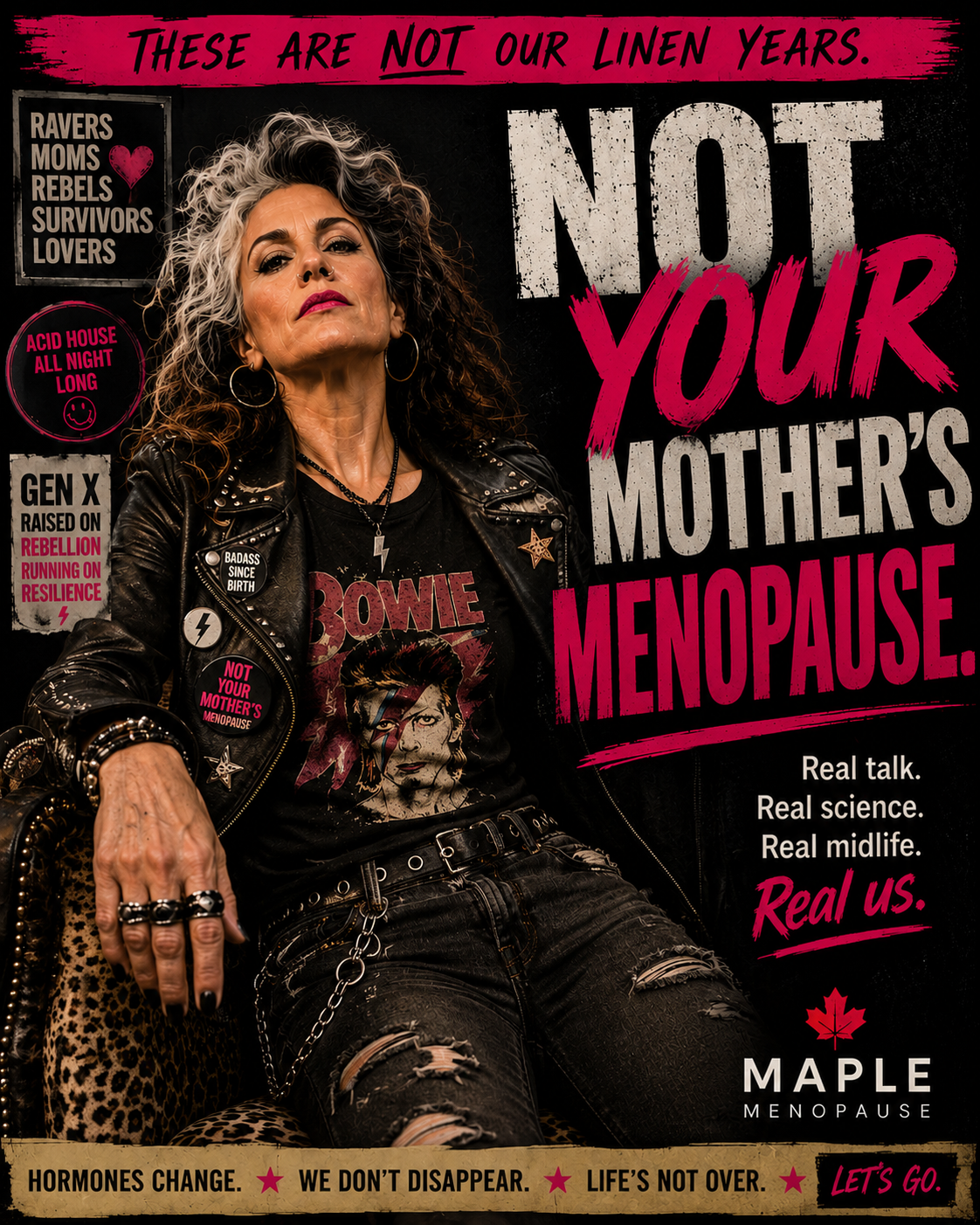
That is changing. The women arriving here now have entire histories behind them. Some went to raves and now compare magnesium brands. Some were punks, goths, hip-hop kids, metalheads, activists, indie obsessives—or none of the above. They built careers, raised children or deliberately did not, stayed married, got divorced, dated again, cared for parents and started over.
Then estrogen became erratic and the culture seemed to expect an immediate change of costume: beige linen, herbal tea and a serene acceptance of everything.
These are not our linen years.
Women are talking about perimenopause and menopause with a frankness that would have been difficult a generation ago. Often, the recognition begins with four small words:
Not only me?
Recognition can change what happens next. It gives a woman language for the appointment, a reason to connect symptoms she had treated as separate, or simply the relief of knowing she has not become inexplicably bad at being herself.
But a louder conversation is not automatically a better one. The old silence is now competing with a very efficient marketplace of hormone-balancing powders, private tests, miracle diets and people who discovered menopause five minutes before launching a course. We need openness. We also need evidence and a functioning bullshit detector.
This matters for decades, not months. Statistics Canada reported female life expectancy at birth of 84.29 years in 2024. Menopause commonly occurs around the early fifties. For many women, postmenopause is a substantial portion of adult life—not a brief epilogue after the supposedly important part.
IN THIS ARTICLE
- The silence had consequences
- When the system treated the pieces, not the pattern
- Research was not built equally around women
- The Women’s Health Initiative—and the shockwave that followed
- Social media broke the silence—and opened a new problem
- What a better inheritance looks like
- Educational information only
- Evidence and further reading
The silence had consequences
Menopause was often reduced to a joke about hot flashes or treated as a private matter to be endured. That narrow picture left women unprepared for the breadth of symptoms that can accompany the menopausal transition.
In a 2022 national survey commissioned by the Menopause Foundation of Canada, 46% of women aged 40 to 60 said they felt unprepared for menopause, 54% believed the subject remained taboo, and four in ten felt alone in their experience. Ninety-five per cent reported at least one symptom.
Those numbers describe more than a communication problem. When women do not know that cycle changes, sleep disruption, mood changes, urinary symptoms, vaginal discomfort, cognitive complaints and hot flashes can occur during the same transition, they may not recognize a pattern worth discussing. They may blame themselves. They may spend years pursuing separate explanations for symptoms that deserve to be considered together.
Not every midlife symptom is menopause. Palpitations, bleeding changes, depression, fatigue and cognitive changes have other possible causes and sometimes need prompt assessment. Menopause belongs in the clinical conversation; it does not get to end the investigation. A useful starting point is the Menopause Symptoms guide.
When the system treated the pieces, not the pattern
Many clinicians care deeply about their patients. A system can still fail women while the people inside it are trying hard. Both things can be true.
Primary care appointments are short. Symptoms cross medical specialties. Menopause education has been inconsistent. A woman may see one clinician about sleep, another about heavy bleeding, another about urinary infections and another about anxiety. Each concern may be assessed appropriately on its own, while no one steps back to ask whether hormonal change is part of the larger picture.
The Canadian survey found that fewer than one in four respondents said their family physician had proactively discussed menopause with them. Among the 41% who sought medical advice, 72% described the advice as unhelpful or only somewhat helpful, and four in ten felt undertreated.
These are self-reported experiences rather than a measure of every clinical encounter in Canada. They nevertheless expose a serious gap between the care women need and the care many believe they received.
The harm is not only untreated hot flashes. Poor sleep can affect work and relationships. Genitourinary symptoms can be painful and recurrent. Heavy or irregular bleeding can be disruptive and may require investigation. Feeling unlike yourself without understanding why can be frightening. So can discovering, years later, that the recurrent urinary infections, painful sex or 3 a.m. wake-ups had a name and possible treatments nobody mentioned. Anger is a reasonable response to that delay. It does not have to be immediately repackaged as personal growth.
Women were not “too sensitive.” Too often, the map was incomplete.
Research was not built equally around women
The knowledge gap did not appear by accident.
In 1977, the United States Food and Drug Administration recommended excluding women of childbearing potential from early phases of many drug trials. The policy was intended to protect potential pregnancies, but its reach was broad—even women using contraception, women whose partners had vasectomies and single women could be excluded. According to the U.S. National Institutes of Health, the result was a shortage of evidence about how drugs affected women.
Policy changed slowly. In 1993, the NIH Revitalization Act made the inclusion of women and racial and ethnic minority groups in NIH-funded clinical research a matter of law. The Women’s Health Initiative, launched in 1991, was a landmark effort involving more than 150,000 postmenopausal women.
That progress matters. So does the legacy of the earlier exclusion. Research questions, diagnostic norms and medical education developed for decades without women being represented consistently. Conditions that primarily or differently affect women received less attention. The years after reproduction were treated too easily as decline rather than a substantial life stage worthy of rigorous study.
The Women’s Health Initiative—and the shockwave that followed
No honest account of modern menopause care can ignore the Women’s Health Initiative, commonly called the WHI.
In 2002, one WHI randomized trial of oral conjugated equine estrogen combined with medroxyprogesterone acetate was stopped early after an average follow-up of 5.2 years. For the trial’s purpose—using that regimen to prevent chronic disease—the overall balance of measured risks and benefits was unfavourable. The findings were important.
The public message that followed was much broader: hormone therapy is dangerous.
That was not an adequate translation of the evidence. The average participant was approximately 63 years old, many years beyond the usual onset of menopause, and the trial studied a particular oral regimen for chronic-disease prevention. It did not answer every question about every formulation, dose, route, indication or woman.
Later analyses and current guidance brought back necessary detail. The Menopause Society states that, for most healthy symptomatic women younger than 60 or within ten years of menopause onset, benefits can outweigh risks. That is guidance about symptom treatment—not permission to prescribe hormones to everyone or use them to prevent chronic disease. Personal history, age, timing, formulation, dose and route still matter. The full Canadian context is in Hormones and MHT in Canada.
The WHI was not “debunked.” Its trials answered important questions about specific regimens and chronic-disease prevention, including genuine risks. The cultural failure was turning those findings into one blunt sentence—hormones are dangerous—and letting that sentence stand in for every woman, product, route, age and reason for treatment. Gen X heard the warning. Many of us never heard the footnotes.
Social media broke the silence—and opened a new problem
Social media has done something medical leaflets and whispered conversations often did not: it allowed women to describe the whole experience in their own language.
A woman talks about waking at 3 a.m. every night. Another describes a sudden loss of confidence at work. Someone names vaginal dryness, rage, joint pain or the feeling that her brain has become unreliable. Hundreds of others respond: Not only me.
That recognition is not trivial. A peer-reviewed analysis of menopause-related Instagram posts found that lived experiences and support needs appearing prominently on social media were less visible in biomedical literature. Women were not merely repeating medical information; they were identifying what research and clinical conversations had failed to capture.
Online communities can reduce isolation, supply useful vocabulary and prompt a person to seek care. They can also transmit outdated advice, confident misinformation and advertising disguised as education. A 2025 survey of online menopause information-seeking found that social media was the second most-used online resource, while emphasizing the difficulty of judging information quality. Nearly one quarter of respondents used the internet without consulting another source.
A personal story can tell us what happened to one person. It cannot tell us what will be safe or effective for everyone.
That does not make the story useless. It makes it a clue. The useful habit is to take questions—not instructions—from social media:
- Treat lived experience as a clue, not proof.
- Look for the original guideline, study or regulator behind a claim.
- Ask who benefits financially from the advice.
- Be wary of certainty, especially promises to “balance hormones,” reverse menopause or cure a long list of unrelated problems.
- Take questions—not instructions—from social media into a healthcare appointment.
What a better inheritance looks like
Our mothers and grandmothers were not passive or prudish. Many were resourceful women working with poor information, fewer acceptable options and a culture that rewarded endurance. Silence was often what the system left them.
We have more language now. We can talk about sleep, bleeding, cognition, mood, sex, bladder changes and hot flashes without assuming that every woman will experience all of them—or want the same treatment. Some women struggle badly. Some barely notice menopause. Most do not emerge as either liberated goddesses or medical catastrophes.
The practical part is less glamorous than the social-media revolution. Track what is changing if the pattern is hard to see. Before a short appointment, use the appointment guide to choose the questions that matter most. If care has stalled, the Canadian care directory explains possible routes forward. And when you want the longer answer on one symptom, the article library is there.
None of that requires turning menopause into a new identity. It is happening to women who already have identities—women with work to do, people to love or leave, music they still turn up too loudly, opinions they have stopped softening and histories no hormone can erase.
Bodies change. What we want, tolerate and choose may change too. But menopause does not arrive with instructions to become smaller, quieter or more beige.
The woman at the centre of it was interesting before her hormones shifted. She gets to decide what happens next.
Educational information only
This article provides general educational information and is not medical advice, diagnosis or treatment. Menopause symptoms can overlap with other health conditions. Discuss new, severe, persistent or concerning symptoms—and decisions about medication—with a qualified healthcare professional who knows your history. Seek urgent care when symptoms may be an emergency.
Evidence and further reading
- Menopause Foundation of Canada: The Silence and the Stigma—Menopause in Canada
- U.S. National Institutes of Health: History of women’s participation in clinical research
- Women’s Health Initiative: Principal results of the estrogen-plus-progestin randomized trial
- National Institutes of Health: WHI findings and clinical messages, 30 years after launch
- What women post about menopause: analysis of menopause-related Instagram content
- JMIR Formative Research: Online information-seeking behaviours of women experiencing menopause
- Menopause Legacies: sharing menopause experiences across generations
- Statistics Canada: Life expectancy in Canada, 2024
- The Menopause Society: 2022 Hormone Therapy Position Statement highlights