
You do not need ten steps, a bathroom warehouse or a working knowledge of snail anatomy. The best K-beauty lesson for midlife skin is much simpler: hydrate more, irritate less.
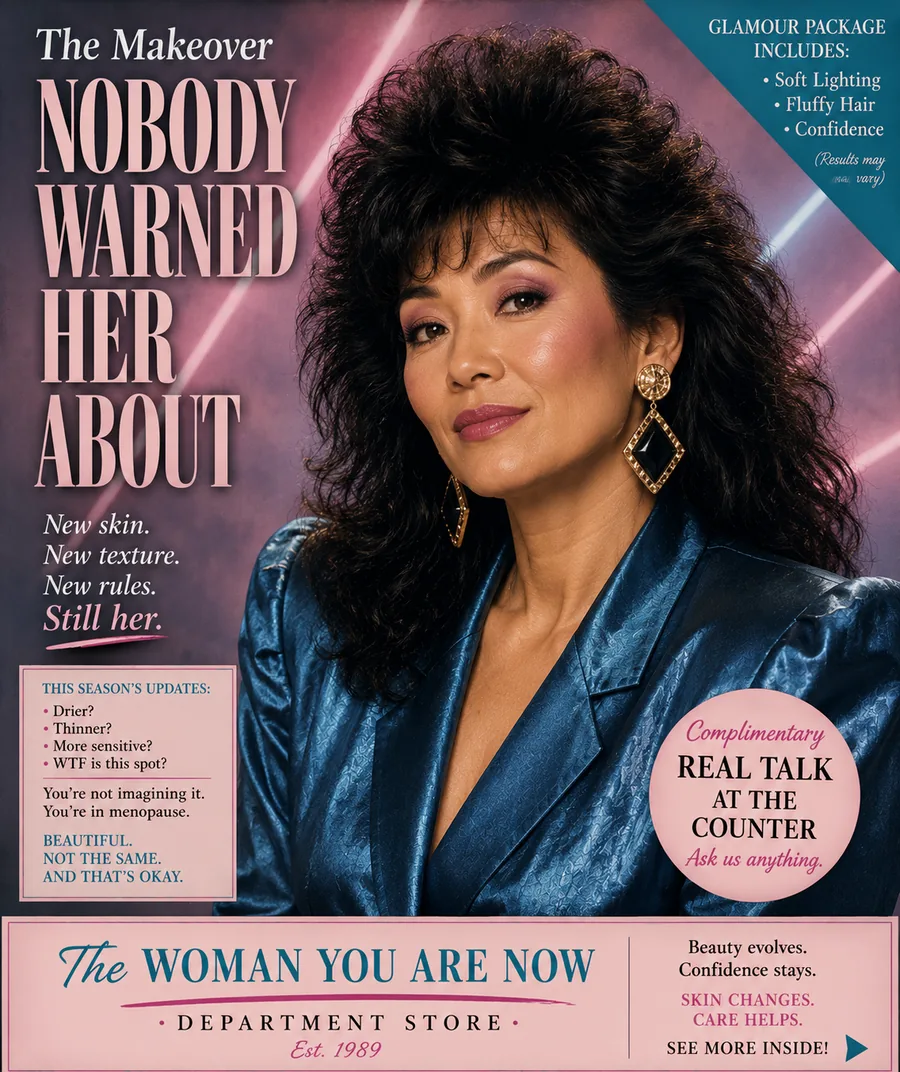
If Korean skincare has sent you into a rabbit hole of essences, ampoules, rice water, ferments and “glass skin,” take a breath. What makes K-beauty useful after 45 is not the number of bottles. It is the emphasis on gentle cleansing, light layers of hydration, barrier-supportive moisturizers and sunscreens people actually enjoy wearing.
If you want the biology first—including what can happen to collagen, hydration, elasticity and the skin barrier—read The Estrogen–Skin Connection. Here, we are decoding the routine.
If dryness is also showing up in your eyes, mouth or hair, skincare cannot solve the whole pattern. When Everything Feels Drier explains what may overlap—and what deserves separate assessment.
IN THIS ARTICLE
What K-beauty can—and cannot—change
Midlife skin often becomes drier and more reactive as oil production, water retention and barrier function change. Collagen and elasticity also decline with age, menopause-related hormonal change and accumulated sun exposure. Those are overlapping processes, not a single cosmetic diagnosis.
K-beauty is a product and routine philosophy, not a biologically distinct treatment system. Its useful habits—gentle cleansing, hydration in comfortable layers, barrier support and diligent sunscreen—can suit midlife skin. The country on the label does not make an ingredient clinically superior.
| Category | What the evidence reasonably supports | What marketing often overstates |
|---|---|---|
| Sunscreen | Broad-spectrum SPF 30 or higher helps prevent additional UV damage and photoaging. | No sunscreen erases existing ageing. |
| Moisturizers, humectants and ceramides | Improve hydration and support a dry or disrupted skin barrier. | Temporary plumping is not new collagen. |
| Topical retinoids | Prescription tretinoin has the strongest evidence for photoaging; over-the-counter retinoids vary and can irritate. | More strength or more peeling does not mean better results. |
| Vitamin C or niacinamide | May help selected pigmentation, tone or barrier concerns when formulated and tolerated well. | They are not substitutes for sun protection or medical assessment. |
| Snail mucin, centella, ferments, rice and ginseng | Some products hydrate or feel soothing; evidence depends on the exact formula. | Ingredient stories and laboratory mechanisms do not prove a product reverses menopause-related skin ageing. |
K-beauty without the vocabulary exam
| Step | What it is | Do you need it? |
|---|---|---|
| Oil cleanser | Removes makeup and stubborn sunscreen | Only when useful |
| Gentle cleanser | Washes without leaving skin squeaky | Usually at night |
| Toner | A watery first layer of hydration | Lovely for dry skin |
| Essence | A hydrating middle layer | Optional |
| Serum or ampoule | A more concentrated targeted product | Choose one |
| Moisturizer | Helps hold hydration in | Yes |
| Sunscreen | UV protection | Every morning |
| Mask | Extra hydration and fun | Entirely optional |
Build the smallest routine that solves the problem
Minimal morning
- Rinse or gently cleanse
- Moisturizer if needed
- Broad-spectrum SPF 30+
Minimal evening
- Cleanse
- One active, only if wanted and tolerated
- Moisturizer
If dryness is the problem
Use a mild cleanser, apply a fragrance-free cream or ointment to damp skin, and pause exfoliating acids while the barrier settles.
If pigmentation is the problem
Start with daily sunscreen. Add one targeted ingredient rather than stacking several brightening products that may provoke irritation.
If fine lines or photoaging are the priority
Sunscreen comes first. A retinoid may help, but introduce it slowly and expect months—not days—for visible change.
If your skin suddenly became reactive
Return to cleanser, moisturizer and sunscreen. Persistent rash, pain, bleeding, a changing mole or a non-healing spot belongs with a clinician or dermatologist.
The famous ingredients—translated
Hydrating and conditioning. Not a facelift.
Helps attract and retain water for temporary plumpness.
Softness, hydration and brighter-looking skin—not reverse ageing.
A soothing category for dry, easily irritated-feeling skin.
Excellent barrier-support territory for tight, flaky or over-treated skin.
Interesting extras after the basics are working.
Toner: not the alcohol bomb you remember
Many Korean toners are lightweight hydration. Pat on one thin layer and add another only if your skin benefits. Toner is optional; it is not required to “prepare” skin for moisturizer.
Essence—and yes, the snail stuff
An essence sits between toner and serum, but you do not need all three. Snail mucin is best treated as an optional hydrating or conditioning step, not a collagen treatment. If the texture makes you recoil, skip it. Skincare is not a character test.
Centella and ceramides: the calm-down department
Centella—often labelled cica—is common in products for sensitive or irritated-feeling skin. Ceramide-rich moisturizers are less glamorous and more important when skin is tight, flaky or over-treated. Judge the complete formula and how your skin responds, not one fashionable ingredient.
Where retinoids fit
Retinoids are not uniquely Korean, but gentle K-beauty layers can work beautifully around one. Let the toner, essence and cream handle hydration and comfort; let the retinoid be the active. More acids and aggressive exfoliation are not automatically better.
Masks: optional, joyful and temporarily impressive
Sheet and hydrogel masks are mainly about hydration, soothing and temporary plumping. That is not rebuilt collagen—but it can still look and feel lovely. The Biodance Bio-Collagen Real Deep Mask is a popular overnight hydrogel style, while the Laneige Water Sleeping Mask is essentially an extra overnight moisturizing layer. Both belong in the fun-extra category, not the compulsory-treatment category.
If your skin is extremely dry
Toner
Second thin layer
Essence
Moisturizer
This is the logic behind “glass skin”: well-hydrated skin reflects light. It is not literally glass, and it is not a new collagen network.
Sudden sensitivity is a reason to simplify, not to add three soothing serums at once. If scalp and hair texture are changing too, the separate menopause hair guide distinguishes strand care from medical hair-loss treatment.
If everything suddenly burns
Stop adding products. Go back to a gentle cleanser, moisturizer and sunscreen. When skin feels comfortable, reintroduce one product at a time. If you start nine adorable bottles on Tuesday and erupt on Thursday, you will have no idea which one did it.
What should you buy first?
Moisturizer
Barrier support first
Hydrating toner
Comfortable light hydration
One fun essence
Snail, centella or another favourite
Sunscreen
The one you will wear
A mask
Because fun is allowed
Sources and further reading
- Canadian Dermatology Association: Dry Skin
- Canadian Dermatology Association: Photoaging
- American Academy of Dermatology: Caring for Your Skin in Menopause
- Topical tretinoin for photoaging: systematic review of randomized trials
The Maple Menopause bottom line
The best K-beauty lesson is not buy more stuff. It is hydrate more; irritate less. Start simply, add one product at a time, keep what your skin genuinely likes and skip what it does not.
Ready for the six-product starter shelf?
Toner, snail mucin, centella, ceramides and two fun masks—without the 47-product haul.
Affiliate disclosure: Maple Menopause may earn a commission from qualifying purchases, at no additional cost to you. Linked products are skincare options, not treatments that reverse menopause-related skin ageing.